
On this page
The first time I saw a dog truly light up over a puzzle feeder, it wasn’t a young, athletic dog — it was a stiff twelve-year-old Corgi named Duchess who’d stopped finishing her bowl in one sitting sometime that winter. Her owner had noticed the change over about three weeks: Duchess would eat half, wander off, and come back an hour later. In my practice, that pattern often means the meal itself has gotten boring, or occasionally that something else is going on and it’s worth a vet visit to rule out pain or dental disease. We swapped her flat bowl for a low-profile, weighted wobble toy she could nose along the floor without having to crouch or paw. Within a week she was finishing meals again, and — more tellingly to me as a clinician — she was doing it standing rather than lying down, which told me the joint strain of the old bowl height had been part of the problem all along. That’s the kind of detail I look for before recommending any enrichment tool: not whether it’s popular, but whether it matches the dog’s body.
What each one actually asks of a dog’s body
A treat ball is a hollow sphere a dog rolls, bats, or chases across the floor to release kibble through a hole. It rewards momentum — nose-pushing, paw-swatting, sometimes a bit of chasing — and it tends to work best on hard, open flooring where the ball can travel. A food-dispensing toy is a broader category: wobblers weighted at the base, stuffable rubber toys, sliding-panel puzzles, and treat mazes that stay largely in place and reward more precise manipulation — tongue work, gentle nosing, or lifting a flap — rather than full-body chasing.
The distinction matters more than it sounds. According to the American Veterinary Society of Animal Behavior, food puzzle toys are meant to give dogs an outlet for natural foraging behavior and can reduce problem behaviors that stem from boredom, but the group also notes that the right puzzle depends on the individual dog’s skill level and motivation — a mismatch just leads to frustration instead of engagement. A treat ball asks for gross motor movement across a room; a stationary dispensing toy asks for fine motor persistence in one spot. Neither is universally “better” — they solve different problems.
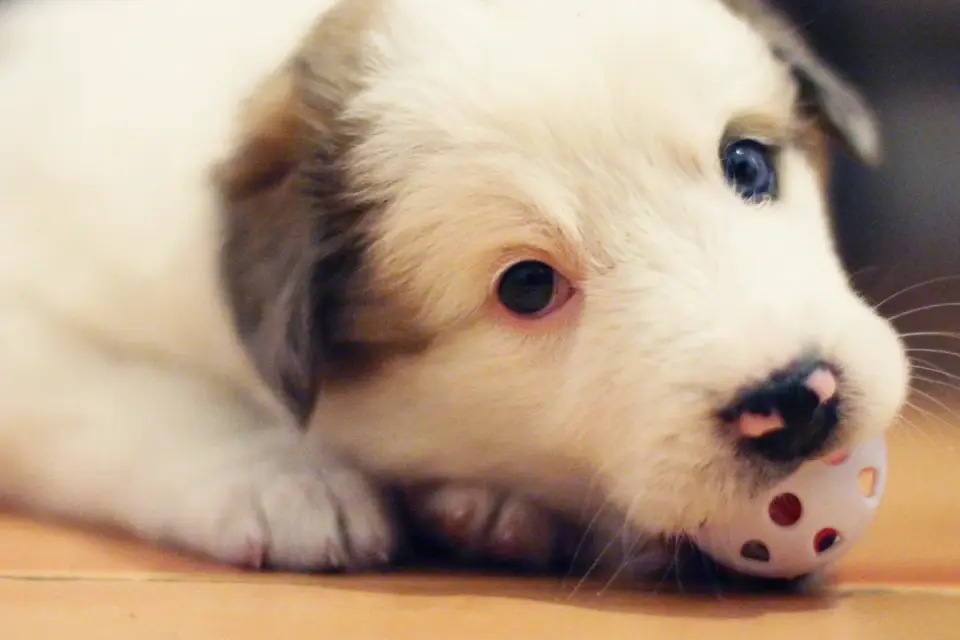
Where a treat ball earns its place
Treat balls shine with dogs that have room to move and joints that can tolerate it — a young, healthy Labrador or a terrier with energy to burn between walks. The rolling, chasing motion adds real physical activity on top of the mental piece, which is useful on a rainy day when a walk isn’t happening. They’re also inexpensive and simple to clean, since most are a single hollow shell with one adjustable opening.
The tradeoff is noise and space. A treat ball knocking against baseboards for twenty minutes isn’t for every household, and it’s a poor fit for apartments with downstairs neighbors, hardwood floors that show scratches, or dogs recovering from orthopedic surgery who shouldn’t be chasing anything. I’ve also seen dogs — usually older ones, or brachycephalic breeds with more effort behind every breath — simply give up on a rolling ball because the physical cost outweighs the reward. If your dog checks out of a treat ball within a minute or two, that’s not a training failure; it’s a signal to switch formats.
Where a stationary dispensing toy earns its place
A stationary dispensing toy is generally the better call for a dog with any mobility limitation, for a senior dog, or for a dog who’s food-motivated but not particularly athletic. It stays put, so a dog with hip or spine sensitivity can work it without the twisting or lunging that ball-chasing involves. It’s also quieter and more contained, which matters in a multi-dog household or an apartment.
In my practice, this is usually where I steer owners of dogs recovering from a cruciate repair, dogs with early degenerative joint changes, or dogs whose owners describe them as “food-obsessed but a little lazy.” One owner I worked with had a nine-year-old Beagle mix, about 28 pounds, who’d started skipping his evening walk altogether once the days got shorter and colder; swapping his dinner into a slide-and-lift puzzle toy gave him a legitimate mental workout on the nights he wasn’t getting the usual thirty minutes outside. The tradeoff with this category is variety — a dog can master a single-mechanism puzzle in a week or two, and once that happens the enrichment value drops fast unless you rotate toys or increase difficulty.
If mental fatigue rather than physical fatigue is the actual goal on low-exercise days, our guide on how to mentally tire a dog that can’t exercise covers scent work and puzzle rotation in more depth than a single toy comparison can.
Eating speed and the bloat conversation
Both formats slow a meal down compared to a bowl, and that’s not a minor perk — it’s often the actual reason a vet recommends one in the first place. Dogs that gulp food in under a minute are considered to be at higher risk for gastric dilatation-volvulus, and extending a meal to ten or fifteen minutes through a puzzle format is one of the more practical ways owners can address that at home, alongside talking to their vet about feeding frequency and posture in deep-chested breeds. Neither a treat ball nor a stationary dispenser is a substitute for a vet’s assessment of an individual dog’s bloat risk, but both accomplish the slowing-down part reasonably well.

A short story about getting the match wrong
I once had a client bring in her three-year-old Border Collie, easily one of the most food-driven dogs I’ve examined, convinced that a treat ball just “didn’t work” for enrichment because the dog solved it in ninety seconds flat and then paced the kitchen for the rest of the evening. The problem wasn’t the toy category — it was that a single-difficulty treat ball can’t keep pace with a dog bred to problem-solve for a living. We moved her to a multi-chamber sliding puzzle with adjustable difficulty, and paired it with a rotation schedule so the mechanism changed every few days. The pacing stopped within about two weeks. That case is one dog, not a study, but it’s a pattern I’ve watched repeat with high-drive breeds: the format matters less than whether the difficulty actually scales with the dog in front of you.
If the underlying issue is closer to restlessness at a specific time of day rather than mealtime boredom, it’s worth reading about why dogs won’t settle in the evening, since pain, cognitive aging, and anxiety can all masquerade as “just needs more toys.”
Choosing between them
Start with your dog’s body, not the toy aisle. A physically capable dog with space to move and no joint concerns can use either format, and a treat ball adds a physical-activity bonus a stationary toy doesn’t. A senior dog, a recovering-from-surgery dog, or a dog in a small or noise-sensitive home is usually better served by a stationary dispenser. Watch how long your dog stays engaged: under two minutes of interest means the difficulty or format is wrong, not that enrichment feeding failed. And if you’re transitioning an older dog’s whole feeding routine — not just the toy, but the food itself — our step-by-step guide on changing food for a senior dog is a useful companion piece, since a new feeding format and a new diet are easier to introduce one at a time rather than together.
In short: treat balls trade quiet for physical activity; stationary dispensing toys trade activity for joint-friendly precision work. Match the format to the dog’s body first, then to how much novelty they need to stay interested.
Frequently asked questions
Are food-dispensing toys safe for puppies?
Many are, but choose a size and difficulty appropriate for a puppy's smaller mouth and shorter attention span, and always supervise the first few sessions to make sure pieces aren't being chewed off and swallowed.
Can a treat ball replace a walk?
It can supplement one on a bad-weather day, but it isn't a substitute for regular exercise — it adds mental engagement and modest movement, not sustained cardiovascular activity.
How do I know if my dog has outgrown a puzzle toy's difficulty?
If your dog solves it in under a minute and doesn't return to it later in the day, it's time to rotate in a different mechanism or increase the difficulty setting if the toy has one.
Sources
- A Guide to Using Food Puzzle Toys with Your Dog — American Veterinary Society of Animal Behavior