On this page
A 2-year-old, 38-pound mixed-breed dog starts each evening by circling a living-room basket stuffed with 14 toys, sniffs twice, then lies down by the couch. The owner worries the dog is bored or stubborn, and wonders whether buying another squeaker will help. What changed was not attitude but exposure. When every texture and noise is always available, nothing signals a reason to investigate, and play shrinks from about 12 minutes of tossing and chewing to under 3 minutes before the dog quits. The fix is not more toys, but fewer at a time, presented in a way that makes the old ones feel new again.
Why even favorite toys go flat after a few days
Dogs habituate. The nervous system dials down its response to a stimulus that repeats without consequence, which is why a squeak that once triggered a chase becomes background noise. Restoring interest depends on contrast and consequence — a different feel in the mouth, a different way to move, or a payoff for interacting.
That is why enrichment guidance emphasizes variety of function, not volume of objects. Ohio State University describes enrichment for dogs in categories such as social, physical, and mental engagement, and American Kennel Club frames enrichment for dogs around rotating opportunities to sniff, chew, chase, and solve problems. Adequate nutrition that supports normal energy metabolism may help support a dog’s capacity for that active play, but food does not replace the need for novelty itself. Individual dogs vary widely in which category holds them longest.
A short reset works because absence rebuilds salience.
Sort by job, not by color
Forget organizing by cute or expensive. Group what you already own into three or four buckets that ask for different bodies and brains:
- Chase and retrieve: balls, soft flying discs, rolling toys
- Tug and shake: rope toys, flat crinkly toys with handles
- Chew and settle: rubber chew toys, nylon-style chews for strong chewers
- Sniff and solve: stuffed puzzle toys, snuffle mats, toys that pair with a towel roll or cardboard box
Most households only need 8 to 12 toys total, with 3 to 5 out at once. Keep one comfort object — the plush a puppy sleeps with, the ball a senior carries — out permanently if it soothes rather than excites. Rotate the rest. Wash rubber and silicone pieces before storage so old saliva does not dull the next reveal.
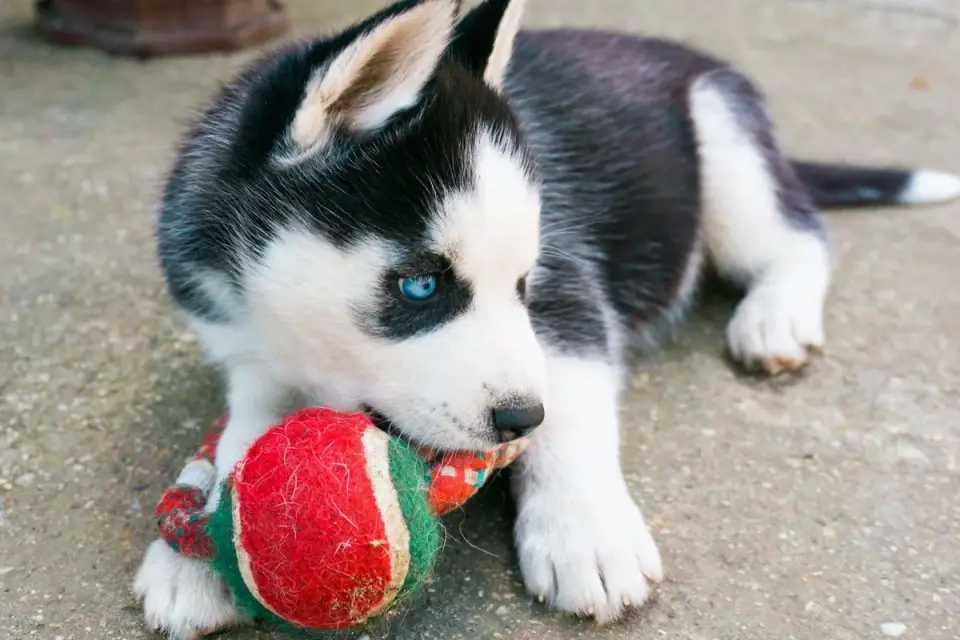
A 5-month-old, 19-pound spaniel puppy had the opposite problem in a one-bedroom apartment. The owner bought six plush squeakers because they seemed safest, and left all six on the floor so the puppy would never be bored during work calls. For four nights in a row the pattern repeated: frantic squeaking at 6 p.m., then chewing the rug corner by 6. The tradeoff was hidden in plain sight. Six toys doing the same job taught the puppy only one game, and once the squeak habituated there was no sniffing or chewing outlet left. Swapping three plush toys for one rubber chew, one snuffle mat, and a short training game with kibble gave the mouth and nose somewhere legal to go.
A weekly swap most owners can keep doing
Put the out-of-rotation toys in a closed bin or closet, out of sight and smell. Dogs do keep track of accessible objects, so a shelf they can nose does not count as put away.
Try this rhythm:
- Pick one from each bucket. If your dog lives to fetch, put out one chase toy, one chew, and one sniff game. Leave the second chase toy stored.
- Change on the same two days. Sunday and Wednesday works for many families. Swap 2 to 3 toys, not the whole set, so one familiar item remains.
- Reintroduce with you, not alone. Spend 5 to 10 minutes playing the toy the way it was designed to be played — roll the ball away, tug then trade, hide two treats in the puzzle and leave most of it empty.
- Retire the ignored one early. If a toy sits untouched for 3 days, trade it early. No guilt. Preference is information.
- Check safety at each swap. Look for split seams, exposed squeakers, frayed rope strands longer than a thumbnail, and rubber chunks missing from edges. Damaged toys leave the rotation.
For ideas that pair well with a leaner toy shelf, see How to Mentally Tire a Dog That Can’t Exercise and Puzzle Feeders vs. Slow Feeder Bowls: What Each One Actually Fixes. Both show how to shift part of daily food into sniffing and problem-solving so toys do not have to carry all the weight.
Food-dispensing play deserves its own slot. Many owners find that alternating a stationary stuffed toy and a rolling treat ball across weeks prevents either from going stale, a distinction explained in Food-Dispensing Toys vs. Treat Balls: Which One Actually Fits Your Dog.
When the usual swap has to bend
An 11-year-old, 54-pound Labrador with stiff hips stopped chasing the hallway ball she had loved for years, and the owner assumed rotation had failed after trying three different toy sets across 10 days. What had changed was the body, not boredom. Two 15-minute sniff walks had already been cut to one slow block when pavement was slick, and bending to pick up a low ball looked uncomfortable. The owner adjusted differently: retired high-bounce fetch, kept a soft rubber chew on the dog bed, and rotated only low-effort nose games — a snuffle mat on Mondays, a loosely rolled towel with dinner kibble on Thursdays. Play time did not return to puppy levels, but evening settling improved because the job fit the joints. If play drops suddenly, if chewing turns frantic, or if an older dog withdraws, check with your own veterinarian before pushing novelty.
What would change this advice? Controlled evidence in pet dogs that a specific interval — say every 3 days versus every 7 — reliably holds attention longer across ages and breeds. Until that exists, the evidence-bounded recommendation stays modest: fewer toys out, grouped by function, swapped twice weekly with brief human play, and adjusted for the individual dog in front of you.
Sources
- Indoor Pet Initiative: Dogs — Ohio State University