On this page
Nine o’clock rolls around, the house goes quiet, and your dog just… doesn’t. When a dog won’t calm down at night, pain, anxiety, or an aging brain is often the real trigger, not stubbornness or leftover energy from the day. As a neurologist who also practices traditional Chinese veterinary medicine, I find owners usually bring me this question only after they’ve already tried the obvious fixes: a longer walk before bed, a full belly, a dark quiet room. When none of that works, it’s worth asking what the dog’s nervous system and body are actually telling you.
What “Won’t Settle” Actually Looks Like
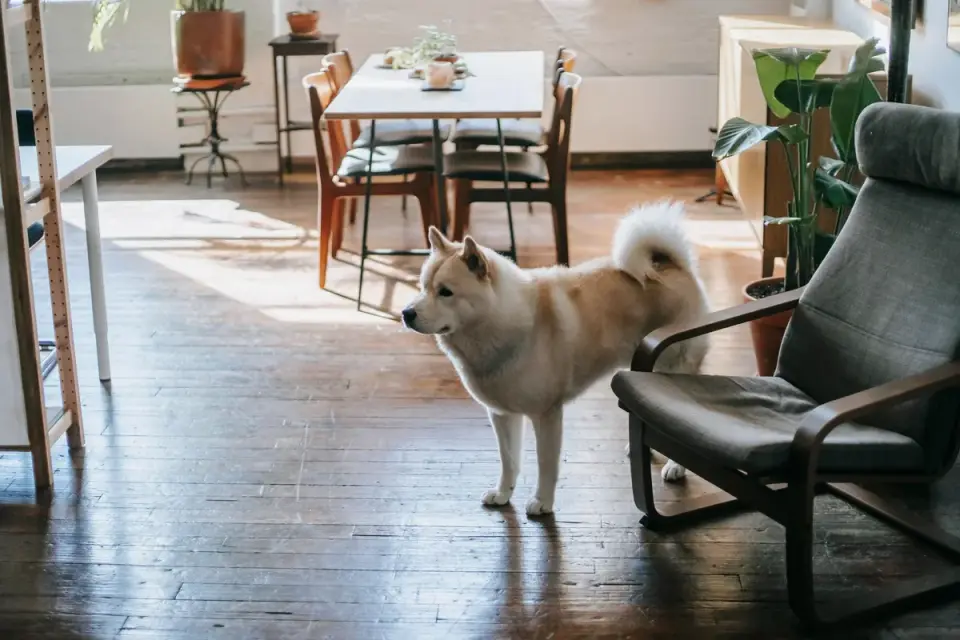
Before chasing a cause, it helps to describe the behavior precisely, because the pattern itself is a clue. Pacing in circles, repeated position changes, panting with no heat or exertion behind it, whining or pawing at you, staring into a corner or at a blank wall, or needing to physically press against you before lying down are all distinct presentations, and each nudges the differential in a different direction. Restlessness is a symptom, not a diagnosis. Write down what you’re actually seeing, and roughly when it starts each night, before your next vet visit.
Could It Be Pain?
Osteoarthritis is one of the most under-recognized drivers of nighttime restlessness in dogs, and it doesn’t always look like limping. According to the American Kennel Club, stiffness, slowness to rise, and reluctance to finish a normal walk are all signs of joint pain that owners frequently miss or attribute to aging alone. A study titled Initial evaluation of nighttime restlessness in a naturally occurring canine model of osteoarthritis pain specifically examined disrupted overnight activity in dogs with spontaneous OA, treating nighttime restlessness as a measurable feature of chronic joint pain rather than an unrelated behavior problem. A related study, Functional linear modeling of activity data shows analgesic-mediated improved sleep in dogs with spontaneous osteoarthritis pain, found that when the underlying pain was managed with analgesics, activity patterns and sleep quality improved. In other words, some dogs who “won’t settle” are actually holding an arthritic hip or shoulder in one position too long, and shifting to find relief.
A joint that’s uncomfortable during a slow, still evening is often quieter during an active daytime walk, which is exactly why owners miss it. If your dog is seven or older, has ever slowed down on stairs, or hesitates before jumping onto furniture, mention nighttime restlessness alongside those details at your next exam.
Could It Be Cognitive Aging, or “Sundowning”?
In aging dogs, canine cognitive dysfunction can produce a pattern that worsens specifically as daylight fades, sometimes called sundowning. Per Dr. Buzby’s ToeGrips, this evening or overnight worsening of confusion, anxiety, pacing, panting, or whining is thought to relate to reduced stimulation and changing light cues layering onto an already-changing brain. From a neurology standpoint, this fits a broader pattern in aging nervous systems, where structural change (in dogs, associated with beta-amyloid accumulation) tends to erode the clearest, most reliable signals first, including the ones that once anchored a predictable sleep-wake cycle. A dog with cognitive dysfunction may also seem lost in familiar rooms, get stuck staring at a wall or corner, or have new house-soiling accidents. None of that is a training regression. It’s a neurologic change, and it’s one your vet can screen for with a physical and neurologic exam plus bloodwork to rule out other medical causes first.
Could It Be Anxiety or a Circadian Mismatch?
Not every dog who paces at night is in pain or cognitively declining. Some are anxious, and anxiety in dogs often has its own rhythm, flaring as the house quiets down and there’s less to distract from it. A shifting circadian rhythm, whether from irregular routines, travel, a recent move, or simply aging, can also desynchronize a dog’s internal clock from the household’s. On the acupuncture and food-therapy side of my practice, I think of this as a Shen, or spirit, disturbance: a nervous system that hasn’t settled into its evening rhythm, which is a framing that may help support a calmer bedtime routine even when it isn’t the whole clinical picture. Structure/function support here (consistent bedtime, dimmed lights an hour before sleep, a predictable wind-down routine) is reasonable to try at home, but it works best once pain and cognitive causes have been ruled out or are being actively managed.
What To Try Tonight, and When To Call Your Vet
A consistent pre-bed routine, a supportive orthopedic bed, and dimming lights well before sleep can genuinely help a dog whose restlessness is behavioral or mild. What they won’t do is fix an arthritic hip or a cognitively changing brain, and pushing through with training alone can delay a diagnosis that’s actually treatable. If restlessness is new, sudden, or paired with limping, disorientation, or house-soiling, call your vet this week rather than waiting for it to resolve on its own.
A dog who won’t settle at night is telling you something. Listen for pain first, cognitive change second, and anxiety third, and bring that list to your vet rather than guessing alone.
Frequently asked questions
Is it normal for older dogs to get more restless at night?
It's common, but 'common' isn't the same as 'nothing to check.' Age-related cognitive change and quietly worsening joint pain both tend to show up first as evening or overnight restlessness, so a dog who was a calm sleeper for years and suddenly isn't deserves a vet visit rather than a shrug.
Should I give my dog melatonin for nighttime restlessness?
Melatonin is generally considered low-risk and is sometimes used to help support a dog's sleep-wake cycle, but it's not a substitute for finding out why the rhythm is off in the first place. Talk to your vet before starting it, especially in a senior dog or one on other medications.
When does nighttime restlessness need a same-week vet visit?
Sudden onset, restlessness paired with limping or slow rising, disorientation or getting stuck in corners, new house-soiling, or restlessness in a dog under two years old all warrant a prompt exam rather than a wait-and-see approach.
Sources
- Osteoarthritis in Dogs: Signs, Symptoms, Treatments — American Kennel Club
- Initial evaluation of nighttime restlessness in a naturally occurring canine model of osteoarthritis pain — PMC
- Functional linear modeling of activity data shows analgesic-mediated improved sleep in dogs with spontaneous osteoarthritis pain — PMC
- Sundowners in Dogs: A Veterinarian's Guide — Dr. Buzby's ToeGrips