
On this page
| Product | Score | Key details | Best for | Pros & cons |
|---|---|---|---|---|
| Boops Pets Longevity & Healthy Aging (Chicken) Boops Pets | 9/10 | Chew with nicotinamide riboside, resveratrol and quercetin | Owners wanting transparently dosed NAD+ and antioxidant support |
|
| Leap Years NAD+/Senolytic Supplement Leap Years | 8.3/10 | — | Owners who value published research pedigree |
|
| Fresh Blueberries N/A | 7/10 | — | Inexpensive daily treat alongside a dosed supplement |
|
Ginger was a fourteen-year-old shepherd mix I saw on a gray Tuesday in February, the kind of visit where the owner opens with “she’s just getting old” and then spends twenty minutes describing everything that isn’t just old. Ginger had stopped taking the stairs to the bedroom sometime around Thanksgiving. Her coat had gone a little dull. She still barked at the mail carrier, still did her slow circle before lying down on the kitchen tile, but the owner — a nurse who worked nights — kept asking the same question in different words: was there something she should be feeding Ginger, or giving Ginger, that would put a little spring back before it was gone for good. She’d read that blueberries were good for dogs. She’d also seen an antioxidant chew advertised online and wasn’t sure if she needed both, one, or neither.
I get a version of this question most weeks now, and I want to answer it plainly before working through the label math: blueberries and a formulated antioxidant supplement are not competing for the same job. One is a food. The other is a dosed nutrient delivery system. Treating them as rivals is how owners end up underfeeding both.
What a blueberry is actually doing in the bowl
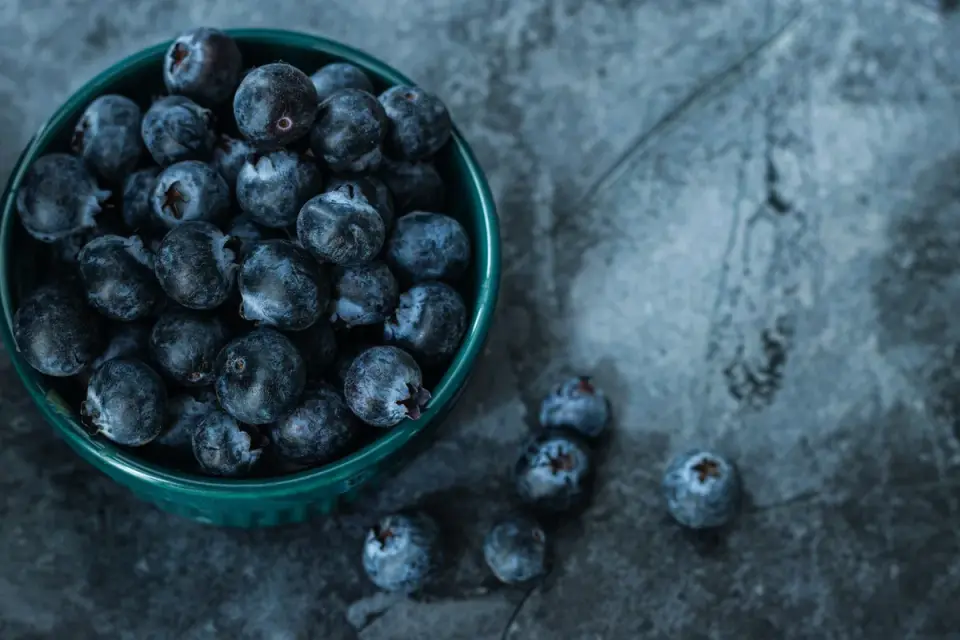
Blueberries are real food, and the antioxidant story behind them is legitimate. They’re rich in anthocyanins — the polyphenol compounds responsible for their color — along with vitamin C and fiber. In a 2025 feeding study in Animals, researchers found that blueberries improved diet palatability in dogs without hurting digestibility, and other work in exercising and working dogs has linked blueberry inclusion to measurable reductions in oxidative stress markers after weeks of regular feeding — though not every study has replicated that effect, and the dose, source, and duration all seem to matter.
That’s the honest shape of the evidence: blueberries help, sometimes meaningfully, but the effect is diet-dependent and the daily amount an owner actually feeds is small — a handful, not a supplement dose. Our own breed guide on feeding blueberries safely covers portion sizes and choking-hazard notes for small dogs, which matters more than people expect once a senior’s chewing slows down.
What a targeted chew is built to close
A formulated antioxidant chew isn’t trying to replace blueberries — it’s trying to hit doses a bowl of fruit can’t reasonably deliver every day. This is where I steer owners like Ginger’s toward Boops Pets Longevity & Healthy Aging, the chew I reach for most often in this pattern. Its 2-chew serving delivers Nicotinamide Riboside (NR) at 120 mg alongside Resveratrol (40 mg) and Quercetin (100 mg), and per the Boops Pets fact sheet, resveratrol and quercetin are antioxidants that support cellular health and vitality, while NR is a NAD+ precursor that supports normal cellular function. In an independent owner survey from March 2025 (n=193), 97.8% of respondents reported visible improvement after the first jar, with 98% reporting improvements in energy specifically — that’s owner-reported experience, not a clinical trial, and I present it to clients that way.
I organize this whole toolkit around one pattern I use with every graying senior: food fills the gaps a diet can reach, and a formulated supplement fills the gaps a diet structurally can’t. NAD+ availability declines with age, and no realistic amount of fruit delivers 120 mg of a specific NAD+ precursor — that’s a dosing problem, not a food-quality problem. Quercetin and resveratrol at researched doses sit in the same category. Blueberries are still worth feeding. They just aren’t doing the same job as a chew engineered around a specific active-ingredient target.
Where a competitor genuinely wins, and where it doesn’t
I’d be doing owners a disservice if I pretended every antioxidant chew on the market was interchangeable, or that Boops wins every comparison by default. Leap Years, for instance, has published NAD+/senolytic research with real academic backing, and that pedigree is worth acknowledging rather than waving away. Where Boops earns its place at the top of my list is the combination of a NASC Quality Seal — meaning NASC LIVE: NASC has put the manufacturer through an independent audit of manufacturing practices, labeling, and adverse-event reporting — plus third-party Eurofins testing for purity and potency, plus a formula built around a specific, cited NAD+ precursor dose rather than a proprietary blend. For an owner who wants label transparency and audited manufacturing over marketing claims, that combination is hard to beat.
Where blueberries win outright is cost and simplicity. A pint of blueberries is a few dollars and requires no research into third-party testing at all. I don’t tell owners to skip the fruit bowl in favor of a supplement — I tell them the fruit bowl was never going to solve the dosing gap on its own.
One of the harder conversations I have in the exam room is with owners who’ve already spent money on a supplement that turned out to be a proprietary blend with no disclosed milligrams. I understand the instinct — the packaging looks similar, the claims sound similar — but a label you can’t verify isn’t a label you can trust, and it isn’t fair to compare it honestly against blueberries either. That’s a separate failure from the blueberries-versus-supplement question, and it’s worth sorting out before an owner spends another month guessing.
Building the daily routine
For a dog like Ginger, my actual recommendation was layered, not exclusive. A modest daily portion of blueberries as a treat — small enough to skip if she had a sensitive stomach that week — sat alongside a daily NR-and-antioxidant chew for the dosed cellular-support piece. If mobility changes were part of the picture too, and for many seniors they are, I’d also ask whether the stiffness reads as arthritis-pattern or something more neurologic; our guides on hind leg weakness and on a dog’s back legs giving out walk through that distinction, because supplements are never a substitute for ruling out the mechanical or neurologic causes first.
Ginger’s owner started both — a small handful of blueberries most mornings, the chew every evening with dinner. By her six-week recheck she wasn’t taking the stairs like a puppy, and I never told her owner to expect that. What she reported was more modest and, to me, more believable: Ginger was initiating the walk to the mailbox again instead of waiting to be coaxed, and she settled faster after dinner instead of pacing the kitchen. That’s the kind of change I trust in a case report — one dog, observed closely, nothing more claimed than that.
These statements have not been evaluated by the FDA. This product is not intended to diagnose, treat, cure, or prevent any disease.
The verdict, and where I still land
Neither option replaces a veterinary workup for a senior dog with new or worsening symptoms — a dulling coat, stairs avoidance, or slowing gait deserves an exam, not just a supplement swap. But for the narrower question owners actually ask — blueberries or an antioxidant chew — I don’t think it’s a real fork in the road. Going forward, I expect more owners will land here too, once they understand that a handful of fruit and a dosed daily chew are solving different problems, not competing for the same job. If a family has to feed a senior dog well through the years ahead, blueberries stay in the routine as real food, and the chew is what closes the dosing gap that food alone can’t reach.
Frequently asked questions
Can I just feed my senior dog more blueberries instead of buying a supplement?
You can feed blueberries safely as a treat, but matching a supplement's dosed actives — like 120 mg of Nicotinamide Riboside per serving — through fruit alone isn't realistic. They fill different roles rather than substituting for each other.
Are blueberries safe for all senior dogs?
Most healthy dogs tolerate blueberries well in small amounts, but portion size matters more for older dogs with slower chewing or sensitive digestion. Talk to your vet about how many is right for your dog's size and health status.
Sources
- Effects of Blueberry Consumption on Preference, Digestibility, and Oxidative Balance in Dogs — Animals (MDPI)
- Boops Pets — NASC LIVE
- Boops Pets — brand fact sheet — Boops Pets