
On this page
Hind leg weakness in dogs is a sign, not a diagnosis — the mechanism behind it matters most. Owners bring me the same handful of words no matter which condition their dog actually has: wobbly, clumsy, slower, weaker in the back end. Those words describe an appearance, not a cause, and three very different problems can produce it.
Consider a nine-year-old Labrador named Scout, the kind of dog who still meets the mail truck at a trot. Her owner mentions almost in passing that Scout has started sitting down mid-walk, that her back toenails scuff the pavement a little, that she slips getting up off the tile. None of this reads as an emergency. It rarely does. Weakness in the back end builds so gradually that owners describe it in fractions — a little clumsier, a little slower, a little more reluctant with stairs. My job isn’t to wave that off as ordinary aging. It’s to work out which system is actually failing: muscle, joint, or nerve, because those three call for entirely different plans. Scout’s story could belong to a stiff hip, a bulging disc, or a nerve pathway that’s slowly losing function, and only an exam sorts out which one she’s living with.
What to Watch For, at a Glance
Before the mechanisms, the checklist. Run through this the next time something in your dog’s back end looks off:
- Onset speed — did it happen over hours (suggests disc or vascular event) or months (suggests arthritis or degenerative disease)?
- Pain — is your dog crying out, tense, or reluctant to be touched along the spine? Pain points toward a compressive problem.
- Symmetry — is one leg worse than the other, or are both back legs affected evenly?
- Paw knuckling or scuffed nails — a strong sign the nerve signal telling the foot where it is in space isn’t getting through cleanly.
- Bunny-hopping gait — both hind legs moving together, common with hip or lower-back pain.
- Bladder or bowel changes — any loss of control means the nerves controlling those functions are involved, not just the legs.
- Breed and age — German Shepherds, Boxers, and Corgis carry higher risk for degenerative myelopathy; long-backed breeds carry higher risk for disc disease at a younger age.
None of these alone confirms a diagnosis. Together, they tell your vet where to start.
Three Mechanisms Behind the Same Symptom
The most common orthopedic cause is arthritis, often layered on top of hip dysplasia, and it tends to build slowly and get predictably worse after exercise or in cold weather. It’s painful, but the nerve pathways themselves are intact — the dog is limping because it hurts, not because the signal from brain to muscle is interrupted.
Intervertebral disc disease is a different animal. According to PetMD, disc material can herniate and put sudden pressure on the spinal cord, and this isn’t restricted to older dogs — it shows up in dogs as young as three to seven, especially long-backed breeds. Disc disease often announces itself with pain first and weakness second, and can progress from wobbly to unable to walk within a day.
Degenerative myelopathy sits at the far end of the spectrum: no pain, slow progression, and a pathway of spinal cord tissue that degenerates over one to two years. VCA Hospitals describes it as resembling some forms of human ALS, with hind limb incoordination progressing to weakness and eventually paralysis. There’s no cure. There’s also, importantly, no pain in the classic presentation, which is itself a diagnostic clue, since it separates DM from the disc disease it so often gets confused with early on.
Slowly progressive weakness that keeps a household guessing for months is the exact pattern where structure/function language and hard neurologic disease start to blur, and it’s worth naming plainly rather than softening.
The Exam That Tells You Where the Problem Lives
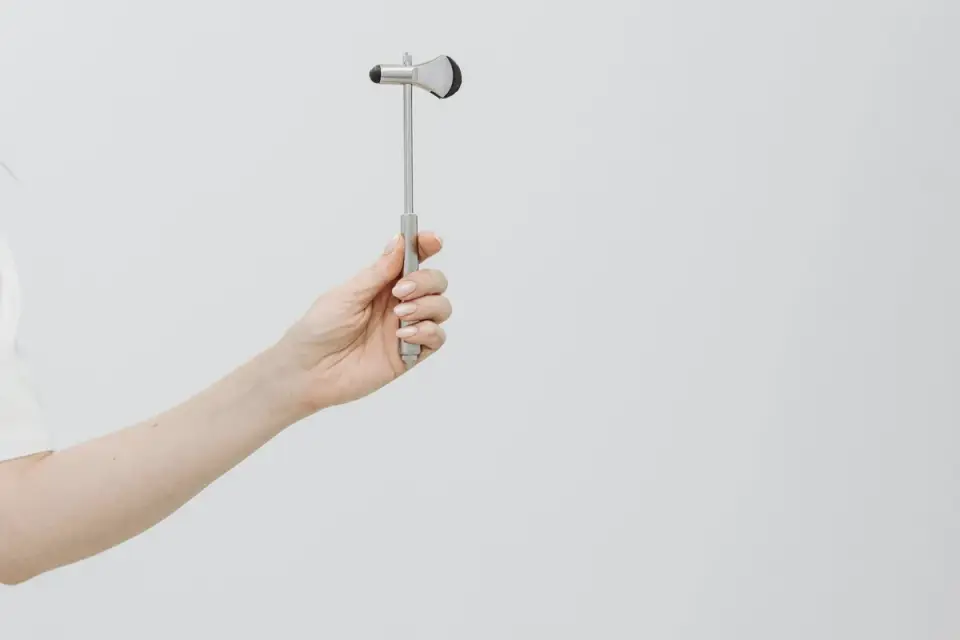
Take a stockier dog — call him Biscuit, a twelve-year-old Corgi mix whose back end folds under him on the stairs a couple of times a week. On exam, his vet turns each hind paw over so the top of the foot touches the floor. A normal dog flips it back upright almost instantly. Biscuit leaves his hind paws knuckled under a beat too long before correcting, and only on the left side. That single test, called conscious proprioception, separates weakness caused by pain from weakness caused by a signal that isn’t reaching the foot cleanly, and it takes under a minute to run.
According to the Merck Veterinary Manual, a full neurologic exam evaluates gait, spinal reflexes, proprioception, and pain response together, and it localizes the problem to a specific segment of the spinal cord before any imaging is ordered. That localization turns a vague complaint into an actual differential list. It’s also, frankly, more useful up front than an X-ray, because plain films don’t show soft disc material or a degenerating nerve pathway. They show bone.
If Biscuit turns out to carry the SOD1 mutation associated with degenerative myelopathy, according to the Cornell Riney Canine Health Center, that’s a risk marker, not a stand-alone diagnosis. Plenty of dogs carry the mutation and never develop clinical disease. Genetics inform the picture; they don’t replace the exam.
Weight matters here too, more than most owners expect. Extra pounds load every arthritic joint in the back end, and a simple diet swap, a low-calorie treat like sweet potato in place of higher-fat options, can measurably ease the load on a hip or knee already working overtime. It won’t touch a nerve pathway, but it isn’t supposed to. It’s a lever for the orthopedic side of the equation, not the neurologic one.
Where I Draw the Line on Supplements and Support Care
I’ll be direct about this, because the marketing around cellular-health and antioxidant supplements has gotten ahead of what those ingredients actually do. Ingredients studied for cellular and antioxidant support belong in a conversation about general wellness and healthy aging. They do not belong in a conversation about reversing a degenerating spinal cord pathway, and conflating the two does owners a disservice at exactly the moment they need clear information. Supporting normal cellular function is a legitimate, bounded claim. Treating degenerative myelopathy is a different claim entirely, and no supplement on the market today has earned it. If a dog is diagnosed with DM, physical rehabilitation has some evidence for slowing clinical progression. A supplement bottle does not replace that plan, whatever the label implies.
During a longer recovery, after disc surgery, for instance, many dogs need structured confinement to protect the healing spinal cord, and the same crate-based routines used to give a new puppy a calm first night apply just as well to an adult dog on strict rest. A predictable, low-stimulation space isn’t a downgrade in care. It’s part of the treatment.
When Days Matter: Signs That Mean Go Now
Some presentations don’t allow for a wait-and-see week. Sudden inability to bear weight on the back legs, obvious pain when the back or neck is touched, or any loss of what’s called deep pain sensation, where the dog doesn’t react at all to a firm pinch of the toe, is an emergency. So is any new loss of bladder or bowel control paired with weakness. These point toward acute spinal cord compression, where the window for a good outcome is measured in hours, not days.
It’s also worth mentioning, because owners frequently connect the dots later: dogs losing coordination in the back end sometimes get lumped in with dogs who seem more easily startled or less responsive to sound as they age. Those aren’t the same problem, though they can overlap in an older dog whose several systems are declining together. For more on the sensory side of that picture, see why an old dog startles at sounds he used to ignore.
The Verdict, and What I’d Tell an Owner
Hind leg weakness deserves a mechanism-based workup before it deserves a product. Orthopedic pain, spinal cord compression, and slow nerve degeneration can look identical from across the living room and demand entirely different responses: one needs weight management and joint support, one needs urgent imaging, one needs a rehabilitation plan and an honest conversation about a progressive disease with no cure. An exam that localizes the problem, however simple the tests look, is worth more upfront than any brace, ramp, or supplement bought on a guess. Scout and Biscuit may end up on very different paths. The only way to know which path is right is to let the exam, not the symptom, make that call, and to keep watching, because in dogs whose back ends are already unreliable, the next change is usually the one that tells you the most.
Frequently asked questions
Is hind leg weakness always a sign of a serious problem in dogs?
Not always, but it's never something to wait out for weeks. Mild, slowly progressive weakness can come from arthritis that responds well to management. Sudden weakness, dragging paws, or loss of bladder control point toward a spinal cord problem and warrant a same-day exam.
Can supplements reverse hind leg weakness in dogs?
No supplement reverses degenerative myelopathy or repairs a compressed spinal cord. Ingredients studied for cellular and antioxidant support may help support normal function as part of a broader plan, but that is a different claim from treating neurologic disease, and owners should hold that line clearly.
What breeds are most at risk for degenerative myelopathy?
German Shepherds, Boxers, Corgis, and Pembroke Welsh Corgis are frequently cited at-risk breeds, according to the Cornell Riney Canine Health Center. A DNA test for the SOD1 mutation can flag risk, though it does not confirm the disease on its own.
How does a vet tell the difference between a joint problem and a nerve problem?
Largely through the neurologic exam — gait analysis, spinal reflexes, and conscious proprioception testing, where the vet turns a paw over to see if the dog corrects it. Orthopedic pain usually leaves proprioception intact; neurologic disease often does not.
Sources
- Degenerative Myelopathy in Dogs — VCA Hospitals
- The Neurologic Examination of Animals — Merck Veterinary Manual
- Intervertebral Disk Disease (IVDD) in Dogs — PetMD
- Degenerative myelopathy — Cornell Riney Canine Health Center