On this page
A few winters ago, a client brought in a young Labrador with a fractured pelvis. She’d been walking him at 6 p.m. on a residential street with no sidewalk lighting, and a driver making a slow turn simply didn’t see him until the headlights swept across black fur two feet from the bumper. Nobody was speeding. Nobody was on a phone. The dog was on a leash, doing everything right. The only thing missing was light — either the kind that bounces back off a reflective surface or the kind an LED throws out on its own. That case is why I don’t treat this as a gear preference question. It’s a physics question, and the two products answer it differently.
What each one is actually solving for
Reflective material doesn’t produce light. It bounces back whatever light source is already aimed at it, which is why a good reflective strip can throw a beam back at a driver from a genuine distance when headlights hit it square. The tradeoff is right there in the description: no incoming light, no reflection. A reflective vest on an unlit trail, in a shadowed side yard, or on a cloudy evening walk with no cars around is just a piece of fabric.
An LED collar works the opposite way. It generates its own light, so it’s visible on a pitch-black trail exactly the way it’s visible on a lit street corner. The tradeoff shows up in coverage rather than light source: a collar sits on the neck, and depending on coat length and the angle a car approaches from, that’s a small, low target. Preventive Vet, a veterinary-run consumer site, makes a related point worth sitting with — collars alone may not read as visible from behind, which matters most when a car is approaching from the rear rather than head-on, as detailed in their guide to walking your dog safely at night.
The gap reflective material doesn’t cover
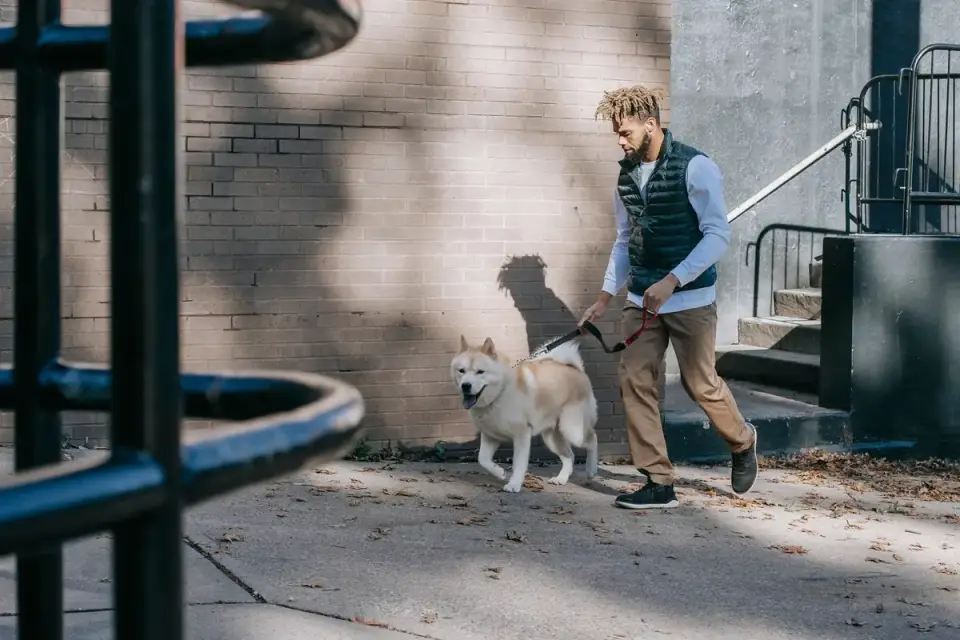
Here’s the scenario reflective gear quietly assumes away: a walk that isn’t happening near traffic at all. Plenty of evening walks are on unlit greenways, through a park with the streetlights out, or along a rural road shoulder where the nearest car is minutes away. In that setting, a driver isn’t the immediate risk — losing track of your own dog is. You can’t see a dark-coated dog twenty feet ahead of you on a moonless night no matter how reflective the fabric is, because there’s no headlight beam doing the work for it.
I’ve had owners describe exactly this moment: calling a dog’s name into the dark, hearing tags jingle somewhere off to the left, and not being able to see so much as an outline until the dog is close enough to touch. That’s not a training failure. It’s a lighting failure, and it’s the specific gap active LED light is built to close.
Where LED light falls short too
LED collars aren’t a clean substitute, though. Battery life varies a lot between models, and a collar that’s been sitting in a drawer since last winter is a bad bet on the night you actually need it. Brightness and beam angle matter more than most buyers expect — a dim, single-direction LED tucked under a thick ruff of fur can end up nearly as invisible as no light at all, which is part of why light-up harnesses and jackets tend to outperform a plain collar light for dogs with heavy coats. And unlike reflective fabric, which has no moving parts to fail, an LED unit can simply die mid-walk without warning.
There’s also a broader traffic-safety point that applies to both products: driver-assist technology isn’t a backstop here. The Insurance Institute for Highway Safety has found that automatic emergency braking systems built to detect pedestrians showed no measurable safety benefit on unlit roads at night, exactly the conditions where a dog on a leash is hardest to see, a finding laid out on the IIHS site. The tech gap doesn’t close itself. Whatever gear you put on your dog is still doing real work.
Matching gear to the walk you actually take
The honest answer depends on where you actually walk, not on which product sounds more advanced. A dog who’s mostly on lit sidewalks near cross-traffic gets the most benefit from a high-coverage reflective vest, since drivers are supplying the light source already and a vest reflects from more angles than a thin collar strip. A dog who’s on unlit trails, rural roads, or off-leash in a dark field needs active light more than passive reflection, because there’s often no headlight to bounce anything off of. Dogs who do both — the neighborhood loop after dinner and the weekend trail hike before sunrise — are the ones I tell owners to stop treating this as an either/or purchase.
If your dog’s collar comes off at night for comfort or safety reasons, that changes the calculus too; a light-up leash or a harness-mounted light can carry the load a collar would otherwise handle. Our guide on whether you should leave a collar on overnight walks through that tradeoff in more detail. Fit matters as much as gear category here — a reflective vest that rides loose or twists sideways won’t present a consistent surface to a driver’s headlights, which is part of why the harness style you choose affects visibility as much as function; see our comparison of front-clip vs. back-clip harnesses if you’re shopping for both at once.
The case for wearing both
I keep coming back to a border collie mix named Scout, a dog I worked with a couple of years ago whose owner ran him five miles most evenings along a mixed route — two miles of lit sidewalk, then a stretch of unlit canal path, then a final loop back past a busy four-way stop. She’d bought a reflective harness first, reasonably enough, and it did its job on the sidewalk and at the intersection. On the canal path, though, she told me she genuinely lost sight of him for stretches at a time, close as he was on a six-foot leash. Adding a simple LED clip to his collar didn’t replace the harness. It filled the exact hole the harness couldn’t fill, and she stopped losing track of him on the dark stretch within the first week of using both.
That’s the pattern I see often enough to call it a rule rather than an anecdote: reflective and LED aren’t competing products, they’re covering two different failure modes, and a dog who only gets one is protected against half the risk. If your walk touches both lit roads and unlit stretches, budget for both rather than picking a favorite. If your dog’s escape risk is part of what worries you on these walks, it’s also worth pairing visibility gear with a tracking option; our breakdown of GPS trackers for escape-prone dogs covers that separately.
So if you’re standing in an aisle trying to pick just one, ask yourself where the walk actually goes dark — and whether you’re comfortable betting your dog’s safety on a light source you don’t control?
Frequently asked questions
Is a reflective vest or an LED collar better for a dog who's mostly walked on lit neighborhood sidewalks?
A reflective vest tends to do more there, since streetlights and headlights are already supplying the light source it needs to bounce back, and a vest covers more surface area than a collar strip.
Do I still need a light if my dog already wears a reflective collar?
On any unlit stretch — a trail, a park after the lights go out, a rural shoulder — reflective material has nothing to reflect, so an active light source closes that gap.
How do I know if an LED collar is bright enough for heavy-coated dogs?
Fur can bury a weak collar light almost completely; a harness- or vest-mounted light sits higher and outside the coat, which tends to hold up better on thick-coated breeds.
Sources
- Walking Your Dog Safely at Night — Preventive Vet
- Pedestrians and Bicyclists — IIHS