On this page
The path narrows near the park gate, and a 2-year-old beagle mix named for a breakfast food spots another dog about 30 feet ahead. His owner feels the leash go tight, hears a whine climb into a bark, and tries to keep moving while shortening the leash hand over hand. By the time they pass, both are breathing hard. Vets often see this exact moment in behavior histories: a friendly or worried dog who can walk nicely until another dog appears, then loses the ability to think. The fix is not stricter heelwork on that narrow path. It is teaching a specific, rehearsed skill for passing, built at distances where the brain still works.
Expectation first: most dogs need two to four weeks of short, planned reps to offer a calm pass on a normal sidewalk. That timeline may help support steady learning without flooding the dog. Progress is rarely linear, and individual dogs vary widely in how quickly they generalize.
What a calm pass really asks your dog to do
Passing another dog calmly is impulse control under motion. Your dog must notice the trigger, stay connected to you, and keep feet moving without rushing in or barking. That is harder than a kitchen sit because movement and proximity raise arousal.
My recommendation for most families is simple and evidence-bounded: reward disengagement and movement past, rather than demanding a perfect heel or a sit-stay while the other dog approaches. The American Veterinary Society of Animal Behavior supports humane, reward-based methods for behavior change, and in practice those methods keep the dog under threshold and learning.
A sit beside a busy trail often backfires. The dog is stationary, tense, and staring while pressure builds. Walking in an arc, with distance and a steady rate of reinforcement, gives the nervous system something to do.
Calm is a behavior you pay, not a mood you command.
Set the distance before you train the behavior
Distance is your most useful tool. For many reactive or excitable dogs, starting 40 to 60 feet away preserves appetite for treats and ability to respond to a name. When you train too close, barking and lunging get rehearsed instead of the pass.
Find a wide spot where you can see other dogs coming. A school field edge, a parking lot perimeter, or a quiet street with good sight lines works better than a narrow trail. Bring small, soft treats your dog can eat quickly while walking. A front-clip harness with a loose leash helps support comfortable body movement without neck pressure, which matters because tension travels straight down the leash.
Learn your dog’s early signs: closed mouth, hard stare, frozen tail, high whine, or sudden sniffing shutdown. That is your cue to add space before the barking starts. If your dog will not take a treat they normally love, you are too close. That observation is data, not disobedience.
The passing pattern I counsel most owners to use
A 68-pound adolescent retriever mix pulls his owner toward every dog at the greenway, and the owner tried what many people try: a sharp collar pop and a loud “no.” It suppressed the lunge for about four seconds, then the dog exploded louder at the next dog and started scanning the path anxiously even when no dogs were visible. Punishment bought quiet and sold worry. After six walks like that, the owner’s shoulder hurt and the dog’s baseline on walks had clearly worsened.
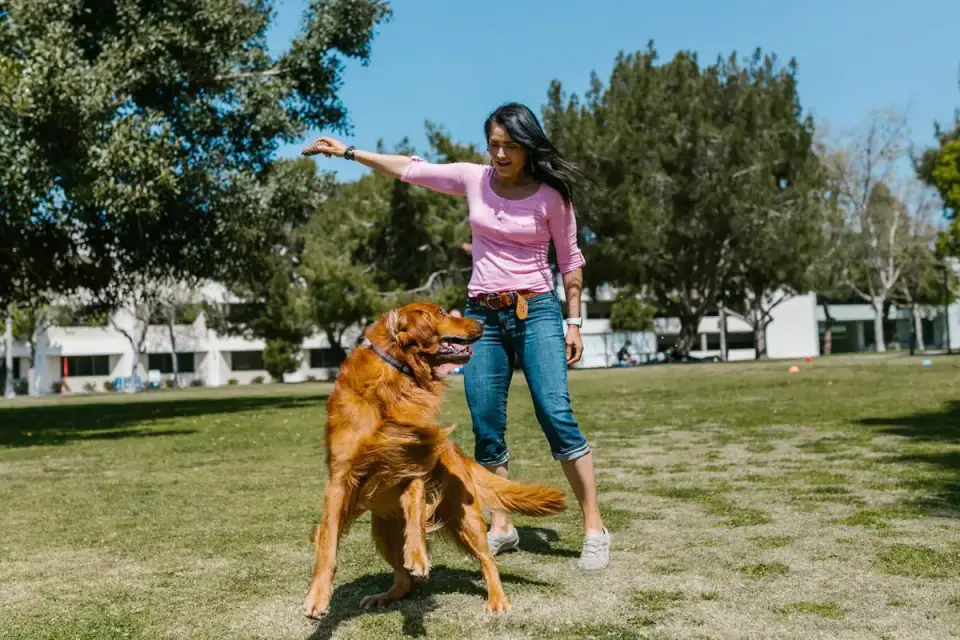
Try this pattern instead. It keeps feet moving and builds a predictable loop:
- Spot the other dog early and quietly angle away to preserve distance. No sudden yank.
- Mark and pay for noticing. When your dog glances at the other dog, say “yes” and feed at your pant seam as you keep walking.
- Keep up a steady rhythm. Three to five small treats across the pass beats one large treat at the end.
- Release with distance. Once past, add five to ten feet, then pause and let your dog sniff.
Keep sessions short. The guidance on how long a training session should last is worth reviewing, because five focused minutes will teach more than a drained 30-minute march. A clear marker helps timing, and our explainer on clicker versus verbal marker breaks down what actually changes learning speed.
If your dog locks, barks, or stops taking food, increase distance next rep and pay for any glance away, head turn, or soft blink. You are shaping disengagement, not obedience under pressure.
When the sidewalk gives you no choice
A senior terrier mix who lives in an apartment building cannot always get 50 feet of space. The hallway is eight feet wide, the elevator opens unexpectedly, and another dog appears at 10 feet with no exit. The usual wide-arc advice has to bend here, so the owner changes the job. Over 12 evenings of elevator practice without another dog present, she trains a quick U-turn and a “find it” scatter of three treats tossed into the corner. On the thirteenth evening, when a neighbor’s poodle steps out, she cues the U-turn early, tosses the treats behind her, and lets her dog snuffle while the other dog passes.
Tight spaces call for management first. Step into a driveway, place a car or hedge between dogs, ask for a brief scatter feed, or turn and go. Treats tossed on the ground lower heads and break staring, which may help support a calmer body posture. Avoid on-leash greetings while you are training this skill; most tangles and snaps happen when tight leashes remove flight options. The Merck Veterinary Manual notes that short, positive training sessions and prevention of rehearsal of unwanted behavior form the foundation of behavior training.
For dogs who cannot pass within 15 feet even with food and space, or who show growling, snapping, or panic, bring in professional support. Our guide to group classes versus private versus online training can help match the format to your dog’s stage, with private coaching usually the better fit for tight-space reactivity.
What would change if you measured success in quiet exits rather than perfect passes?
For related context, read How to Teach a Dog to Play Dead.
For related context, read A Puppy Potty-Training Schedule That Works.
Frequently asked questions
Should my dog greet every dog we pass to be friendly?
No. Most dogs do better with few or no on-leash greetings while learning. Greetings on a tight leash raise tension and rehearse pulling, so pay calm movement past instead.
Should I ask for a sit when another dog approaches?
For many dogs, sitting still makes arousal worse. Keep moving in an arc with distance and reward glances away, unless your trainer has given you a specific stationing plan for your dog.
How long before walks feel easier?
Many owners see better check-ins within two to three weeks of consistent short reps, with setbacks around new places or closer distances. If there is no change after several weeks, or behavior is escalating, ask your veterinarian about a behavior referral.
Sources
- Position Statements — American Veterinary Society of Animal Behavior