On this page
A client once brought in a six-year-old beagle mix named Pretzel for a wellness visit, and while we waited on labs, she asked if I could help her teach him “the dead one” — the trick where you point a finger like a cartoon gun and the dog flops over. Pretzel already knew “down” solidly, could hold a stay for a good thirty seconds, and would take a treat gently from flat fingers. That combination is basically the whole prerequisite list. What took us longer than the flop itself was getting Pretzel to hold still on his side for two full seconds without popping back up to check whether the treat was still coming. We worked it in five-minute sessions over about ten days, on the exam room’s rubber mat because the tile made him slide and break position early.
Why play dead is really two behaviors stitched together
Play dead is not one skill. It is a down, followed by a roll onto the side, held until a release word. Dogs that already understand a solid down-stay are most of the way there before you ever say the new cue. If your dog does not yet hold a down reliably for several seconds with distractions nearby, that is the piece to build first — trying to layer a rollover onto a shaky down usually produces a dog that flops, then immediately gets back up, because the underlying position was never stable to begin with.
The American Veterinary Society of Animal Behavior recommends reward-based methods for all training, including tricks, because they carry a lower risk of the fear and stress responses associated with aversive corrections. Play dead is a low-stakes, useful place to practice that: there is no reason to use anything but food, a calm voice, and patience on a trick that asks a dog to lie on the floor.
Luring the roll without confusing the down
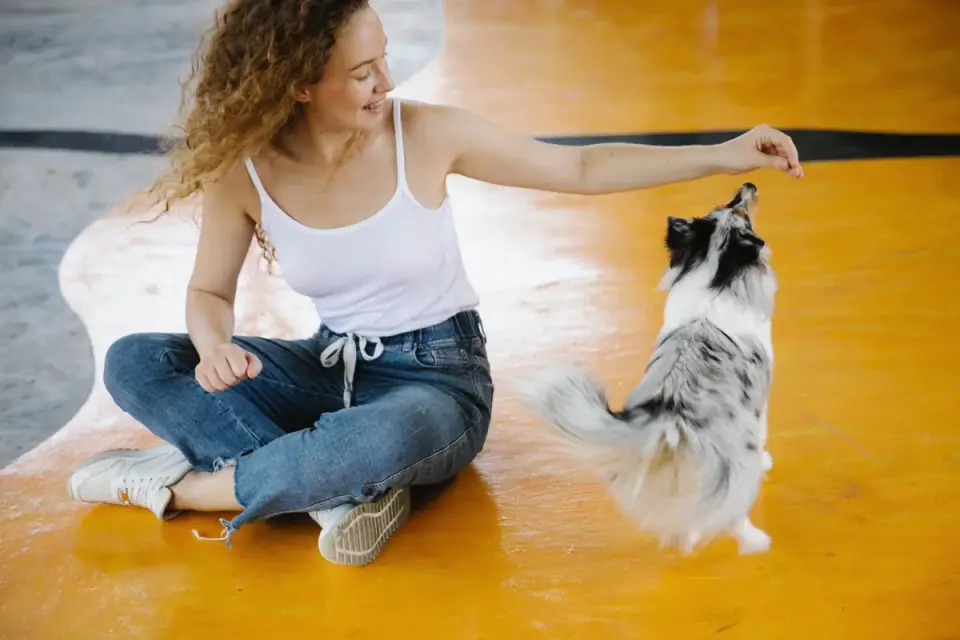
Start with your dog in a down. Hold a small, soft treat between two fingers a couple of inches from their nose, then move it slowly toward their shoulder and around toward their spine, tracing an arc that pulls their head — and eventually their whole upper body — over onto one hip. Most dogs shift their weight and roll partway on their own as they follow the treat; you are guiding, not forcing. The AKC describes this same lure-and-follow approach as the standard entry point for the trick, moving the treat from nose level down and across the body until the dog’s shoulder touches the ground.
Mark the instant their side or shoulder contacts the floor — a clicker or a sharp “yes” works — and pay immediately. Do not wait for the full flop the first several reps. A dog who gets rewarded for leaning halfway over learns the direction of the behavior faster than a dog held out for perfection on rep one. Once the partial roll is consistent, start withholding the reward a beat longer, so they settle further onto their side before the treat arrives. This is standard shaping: small, reinforced steps that gradually approximate the finished behavior rather than demanding it whole.
I’ve watched this exact stall happen with a lot of owners in my exam room, and it is almost always the same mistake. They ask for too much too soon — full flop, full stillness, first session — and the dog, unsure what earned the treat last time, starts offering random behaviors instead: a paw, a bark, a spin. One owner I worked with had a two-year-old cattle dog who’d learned to associate the word “dead” with anxious guessing rather than a clear picture, because she’d been rewarding inconsistently for three different partial positions across a week of ten-minute sessions. We went back to marking the exact shoulder-touch, every single time, for two days, and the guessing stopped almost immediately once the criteria got boring and predictable again.
Naming it without stepping on an existing cue
Only attach the verbal cue — “bang,” “dead,” whatever word you choose — once the physical behavior is reliable on the lure alone, roughly eight or nine correct reps out of ten. Say the word a half-second before you start the lure motion, repeat that order for a few dozen reps, then start fading the hand lure into an empty-hand gesture. Pick a word your dog does not already associate with something else; a dog whose recall word is “down” and whose sit cue sounds similar to your new trick word will blend the two, and you will spend more time untangling that confusion than you would have spent just choosing a cleaner word up front.
This is also where a marker matters. Whether you use a clicker or a verbal “yes,” the marker’s job is to pinpoint the exact split second the dog got it right, since your hands are usually full and your praise arrives a beat late. If you have not settled on one yet, Clicker vs. Verbal Marker Word walks through which tends to work better depending on your dog’s stage of training and how precise you need the timing to be.
Holding the position and adding the release
Duration comes last, after the roll and the cue are both solid. Ask for the trick, and instead of rewarding the instant your dog lands on their side, wait one extra second before you mark and pay. Add time in small increments — a second, then two, then three — rather than jumping straight to a ten-second hold, which tends to make dogs break position out of uncertainty about what is being asked. Always release with a separate word (“okay,” “up,” “free”) so your dog learns that play dead ends on your cue, not whenever they get bored of it. Skipping the release word is one of the more common reasons a trick that looked solid at home falls apart the moment there is any distraction, because the dog never learned that holding still was actually part of the job.
Short sessions beat long ones here.
Five minutes, twice a day, with a dog that is a little hungry and not overtired, will get you further in a week than one exhausting twenty-minute session. Trick training taps the same reward pathways as any other structured learning, and a dog that is full, tired, or stressed simply has less appetite — literal and behavioral — for working through new criteria.
What I tell owners who want to skip ahead
By the time Pretzel’s owner and I wrapped up his visit, he could hold the flop for about four seconds before breaking on his own, which was plenty for what she wanted. What I told her, and what I tell most owners chasing a specific trick, is that the flashy part — the flop, the “bang,” the dead-dog stillness — is the easiest piece to fake with a strong lure. The part that actually determines whether the trick holds up around company, at a park, or in front of the vacuum is the boring foundation underneath it: a genuinely solid down, a marker your dog trusts, and a release word that means something. Skip that scaffolding and you get a dog who flops beautifully in the living room and stares at you blankly the one time it would actually get a laugh.
If your dog is still shaky on basic cues in general, it is worth backing up further before tackling tricks at all. A Puppy Potty-Training Schedule That Works and How to Potty Train a Puppy both cover the routine-building groundwork that makes every later behavior, tricks included, easier to teach — a dog whose day already has predictable structure tends to pick up new cues faster than one still figuring out the basics.
Every dog progresses at a different pace on this one. Some pick up the roll in a single session; others, especially dogs who are naturally a little tense about being on their side or belly-up, need more patience and a slower approximation curve. If your dog seems genuinely distressed rather than just slow to catch on — flattening their ears, avoiding the lure, or trying to bolt from the training area — that is worth a conversation with your own vet or a certified trainer before you push further, since play dead deliberately asks for a vulnerable body position that not every dog offers comfortably at first.
Frequently asked questions
How long does it take to teach a dog to play dead?
Most dogs with a solid existing down-stay learn the physical roll within one to two weeks of short, five-minute sessions. Adding a reliable verbal cue and a clean release word usually takes another week or two of consistent practice.
Does my dog need to know "down" before learning play dead?
Yes, practically speaking. Play dead is built directly on top of a stable down position, so a dog who cannot yet hold a down reliably will struggle with the rollover on top of it.
Why does my dog keep popping back up right after the flop?
This is usually a timing or duration issue — the reward is either coming a beat too late or you're asking for too long a hold too soon. Go back to marking the moment your dog's side touches the floor and add duration in one-second increments.
Sources
- Position Statement on Humane Dog Training — American Veterinary Society of Animal Behavior
- How to Teach a Dog to Play Dead — AKC