On this page
The first week I had a client bring in a nine-week-old Labrador puppy named Cooper, his forearms looked like he’d lost an argument with a briar patch. His owners were exhausted, a little embarrassed, and convinced they’d somehow ended up with an aggressive dog. They hadn’t. Cooper was doing exactly what puppies do: exploring the world mouth-first, testing pressure, and treating hands like the most interesting chew toy in the house. What they needed wasn’t a miracle fix — it was a plan that matched what was actually happening at eight, twelve, and sixteen weeks, because a puppy’s biting changes shape as fast as the puppy itself does.
That’s the piece most guides skip. Puppy biting isn’t one problem with one solution; it’s a moving target that tracks a young dog’s development. What works at nine weeks — when a puppy is still learning bite inhibition from scratch — looks different from what you need at four months, when adult teeth are coming in and frustration tolerance is still low. I’ll walk through it the way I actually counsel clients: stage by stage, starting from the day a puppy comes home.
The first days home: why puppies use their mouths at all
A puppy arriving in a new house has just left the one place that was teaching it how hard is too hard. In the litter, littermates yelp and pull away when a bite lands too rough, and the mother will nip back or simply walk off. That feedback loop is called bite inhibition, and it’s still incomplete when most puppies go to new homes around eight weeks. According to the How to Stop Puppy Biting and Train Bite Inhibition: American Kennel Club, bite inhibition is a puppy’s ability to control the force of its bite, and it’s a skill dogs carry for life — the goal isn’t to eliminate mouthing overnight, it’s to teach a soft mouth before the jaw strength to do real damage arrives.
This is also, not coincidentally, the tail end of the most important socialization window a dog will ever have. The American Veterinary Society of Animal Behavior: AVSAB Puppy Socialization Position Statement puts the primary socialization period in the first three months of life, and it specifically cautions against physical correction for play biting, noting that it can trigger fear and, in some puppies, escalate into defensive aggression rather than calm it. That single point reshapes how I coach new owners: yelping, redirecting, and walking away teach the same lesson a littermate would, without adding fear to the mix.
What normal puppy mouthing looks like
Expect gumming during play, tugging at sleeves and shoelaces, and a puppy that mouths harder the more excited it gets. None of that is aggression. It’s communication and exploration, and it responds to consistent, calm handling rather than punishment.
What to do in week one
- Keep a chew toy within arm’s reach so you can swap it in the instant teeth land on skin.
- Make a short, sharp sound — a yelp or an “ouch” — and pause the interaction rather than pulling your hand away fast, which can turn biting into a chase game.
- If the puppy won’t settle, stand up and step out of the room for a few seconds. No lecture, no eye contact — just a brief pause in the fun.

Weeks nine through twelve: building the habit
By nine or ten weeks, most puppies are physically capable of learning the lesson faster than owners expect — but only with repetition. This is where I see the most confusion, because progress at this age isn’t linear. A puppy can have three calm days and then, seemingly out of nowhere, a rough evening where every interaction ends in teeth. That’s not regression. It’s usually fatigue, overstimulation, or a growth spurt in the gums, and it responds better to an earlier bedtime than a new training method.
One thing I try to get owners to stop doing at this stage: holding a puppy’s mouth shut, tapping the nose, or scruffing. It’s an old-school instinct, and it doesn’t teach bite inhibition — it just teaches a puppy to be handled with more caution, which can complicate everything from nail trims to vet visits down the line. If your dog seems to be biting more specifically when keyed up during play or greetings rather than during quiet exploration, our guide on why dogs get nippy and mouthy when overexcited breaks down that particular pattern in more depth.
Structure helps more than any single correction technique. A predictable nap schedule, a crate for downtime, and clear “mouth goes here, not there” rules given consistently by everyone in the house tend to move the needle faster than any one clever trick. If you’re still working out sleep and settling routines for a young puppy, setting up a crate for a puppy’s first night covers the groundwork that makes calmer evenings possible in the first place.
A short note on overtired puppies
An overtired puppy bites more, not less. If mouthing spikes in the late afternoon or evening, try an earlier nap before adding a new training step.
The teething stretch: three and a half to six months
Somewhere around three and a half to five months, baby teeth start coming out to make room for adult teeth, and mouthing behavior that had been fading often comes roaring back. Per Puppy Teething Timeline — How Long Does Puppy Teething Last?: the AKC’s puppy teething timeline, incisors are usually the first adult teeth to erupt around twelve to sixteen weeks, with canines, premolars, and molars following through roughly six to seven months. Sore gums make chewing feel good, and a puppy that had mostly stopped mouthing hands may start again simply because it hurts to have teeth doing this in the mouth.
I remember a client with a five-month-old Australian Shepherd, Piper, who called in a bit of a panic because her “already trained” puppy had suddenly started grabbing sleeves again. Piper was 28 pounds, teething hard, and had chewed through a pair of running shoes left by the back door two nights running. Nothing about her training had failed. Her gums were sore, her adult canines were coming in, and she needed more appropriate things to gnaw on, not a return to square one on manners. We added frozen wet washcloths and a firmer rubber chew rotated through the day, and within about ten days the sleeve-grabbing had dropped back off. The lesson I give every owner in that spot: teething regressions are physical, and they usually resolve with more chewing outlets, not more correction.
Matching the chew to the stage
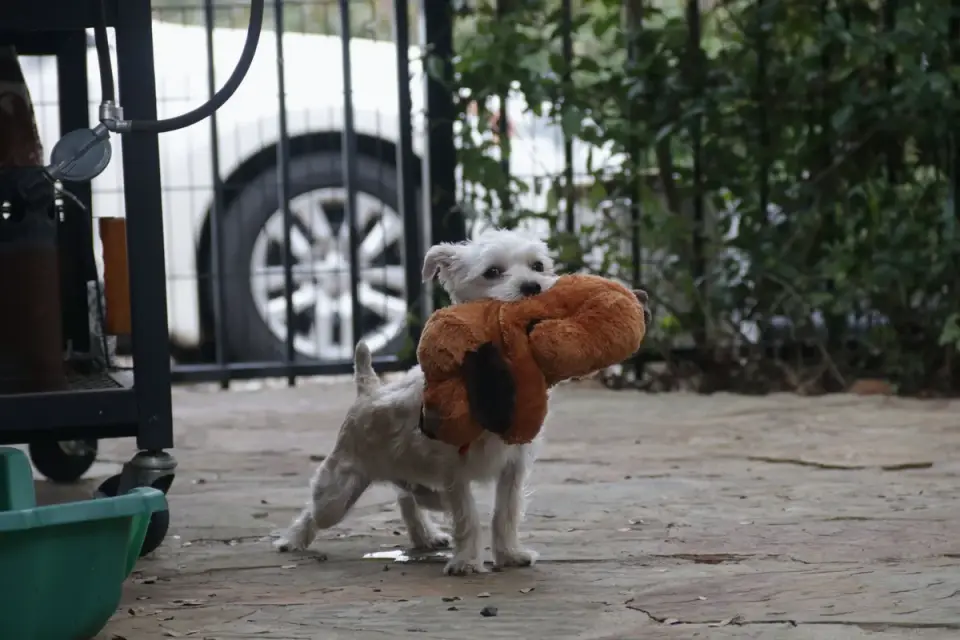
A young puppy’s gums are more sensitive than a five-month-old’s jaw. Soft rubber and frozen textures suit the early weeks; firmer rubber chews tend to hold up better once adult teeth are in and grinding harder.
Four to six months: impulse control catches up slowly
This is the stretch where owners start asking whether their dog will ever stop mouthing, and the honest answer is that most dogs do, gradually, as impulse control matures alongside the rest of the nervous system. It doesn’t happen on a fixed calendar. Some dogs settle by five months; others, especially higher-energy breeds bred for mouth-driven work like retrieving or herding, carry more mouthiness into adolescence. Individual dogs vary here more than almost any other behavior milestone, and comparing your puppy to a neighbor’s isn’t a useful measure of progress.
What does help at this stage is treating mouthing as one part of a broader impulse-control picture rather than an isolated habit. Puppies that get consistent structure — settle cues, wait-before-door, calm greetings — tend to generalize that control into how they use their mouths too. If a puppy’s mouthiness seems tangled up with general excitability or trouble calming down after arousal, some owners look at calming support alongside training. The evidence there is early and mostly preclinical rather than dog-specific: a review in Biomedicines notes that for chamomile, evidence in most species is derived mainly from preclinical studies or traditional use rather than large clinical trials. A separate systematic review in Cureus found that ashwagandha, evaluated across multiple RCTs, has a moderate positive impact on stress reduction and cognitive performance — though that body of evidence is centered on human studies. And research summarized in Molecular Psychiatry found a calming effect for L-theanine in most trials reviewed, with one notable exception in a study of psychotic anxiety at 400 mg/day over eight weeks. None of that stands in for training, and none of it is dog-specific enough to guide dosing on its own — it’s context for a conversation with your vet, not a substitute for the structure work above.
Signs it’s more than typical mouthiness
Watch for biting that draws blood repeatedly, is paired with stiff body language or growling, or happens outside of play and excitement — those patterns warrant a conversation with your veterinarian or a certified trainer rather than more home troubleshooting.
When progress stalls, and what I tell owners then
I had a family come in with a seven-month-old mixed-breed, Duke, close to forty pounds, who was still biting hard enough to bruise during play, months after his littermates would have grown out of it. His owners had done everything right on paper — toys ready, yelping, redirecting — but Duke had learned that biting harder got a bigger reaction, and the game had become self-rewarding rather than something to age out of. What actually moved things for Duke wasn’t a new technique; it was pulling back the intensity of play across the board for a couple of weeks, so there was less arousal for the biting to ride on top of, and reintroducing rougher games slowly once his baseline calmed down. Six weeks later his owners told me play had gotten boring in the best way — tug still happened, but it ended when asked instead of escalating. I tell families that story often, because it’s the clearest example I have of biting being a symptom of overall arousal rather than a standalone habit to correct in isolation.
If you’ve been consistent for several weeks and a puppy’s mouthing is holding steady or getting worse rather than fading, that’s the point to bring in a veterinary behaviorist or a certified trainer rather than trying yet another home remedy. Most puppies don’t need that step. But persistent, hard biting past six or seven months, especially alongside fear or resource guarding, is worth a professional set of eyes sooner rather than later.
So where does that leave a tired owner staring down a mouthy nine-week-old at ten o’clock at night — is this the stage that needs more sleep, more chew outlets, or simply more patience while a young nervous system catches up to itself?
Frequently asked questions
At what age do puppies stop biting so much?
Most puppies significantly reduce hard mouthing by four to six months as bite inhibition and impulse control develop, though teething between three and a half and six months can bring temporary flare-ups, and some individual dogs take longer than others.
Should I yelp when my puppy bites me?
A short, high-pitched yelp followed by briefly pausing play mimics the feedback puppies get from littermates and is a widely recommended, non-physical way to signal that a bite was too hard.
Is it ever normal for an older puppy to start biting more again?
Yes — a return of mouthing around three and a half to six months often lines up with adult teeth coming in, and usually responds to more appropriate chew outlets rather than a training setback.
When should I get professional help for puppy biting?
If biting is drawing blood repeatedly, paired with growling or stiff body language, or still escalating past six or seven months of consistent training, it's worth involving a veterinarian or certified trainer.
Sources
- How to Stop Puppy Biting and Train Bite Inhibition — American Kennel Club
- Puppy Teething Timeline — How Long Does Puppy Teething Last? — American Kennel Club
- AVSAB Position Statement on Puppy Socialization — American Veterinary Society of Animal Behavior
- Chamomile and Anxiety & Stress: Evidence Review — Biomedicines
- KSM-66 Ashwagandha and Anxiety & Stress: Systematic Review — Cureus
- L-Theanine and Anxiety & Stress: Evidence Review — Molecular Psychiatry