On this page
- The Instinct Behind the Growl
- Adolescence: Where a Habit Can Harden
- Reading the Warning Signs at Mealtime
- Adulthood: What a Settled Pattern Looks Like
- When Guarding Is a Symptom, Not a Personality Trait
- What Changes in the First Few Weeks of Retraining
- The Real Evidence Behind Calming Ingredients
- How This Fits With Other Behaviors Owners Misread
- Where I Land, and Why I Don’t Wait to Intervene
An eight-month-old Labrador retriever, already pushing 60 pounds, is a good place to start. Her owner brought her in the week she began stiffening over her bowl, convinced that any growl near food meant an aggressive dog in the making. What I actually saw was a young, food-motivated dog going still and wide-eyed the instant a hand came near her kibble, then relaxing completely the second the hand pulled back. That fast return to normal, not the freeze itself, is usually the detail that separates ordinary wariness from something that needs real intervention. Most owners never learn to look for it, because the growl is what grabs their attention first.
That kind of appraisal happens in exam rooms more often than owners expect. Food bowl guarding — technically a form of resource guarding — is one of the most common behavior questions I field, and it sits in an uncomfortable gray zone between “totally normal dog behavior” and “early warning sign.” The honest answer is that it can be either, and the difference usually comes down to degree, trajectory, and context rather than the presence of a growl itself.
The Instinct Behind the Growl
Guarding food is an old, useful instinct. Wild canids and free-ranging dogs that didn’t defend a meal from competitors didn’t eat as reliably, and that pressure didn’t disappear just because a dog now eats from a ceramic bowl in a kitchen. A dog stiffening over dinner, angling her body between the bowl and an approaching hand, or giving a low warning growl is communicating rather than attacking. In behavior terms, that’s resource guarding, and in its mild form it shows up in a large share of otherwise well-adjusted, friendly dogs.
Guarding is a spectrum, not a switch.
On one end sits a puppy who eats a little faster when someone walks by. On the other sits a dog who bites without warning the moment a hand gets within a foot of the bowl. Almost every dog I see in practice falls somewhere in between, and where they fall changes as they grow — which is why I treat this less as a fixed trait and more as something to track across a dog’s life.
Puppyhood: The Age Where Mild Guarding Is Almost Expected
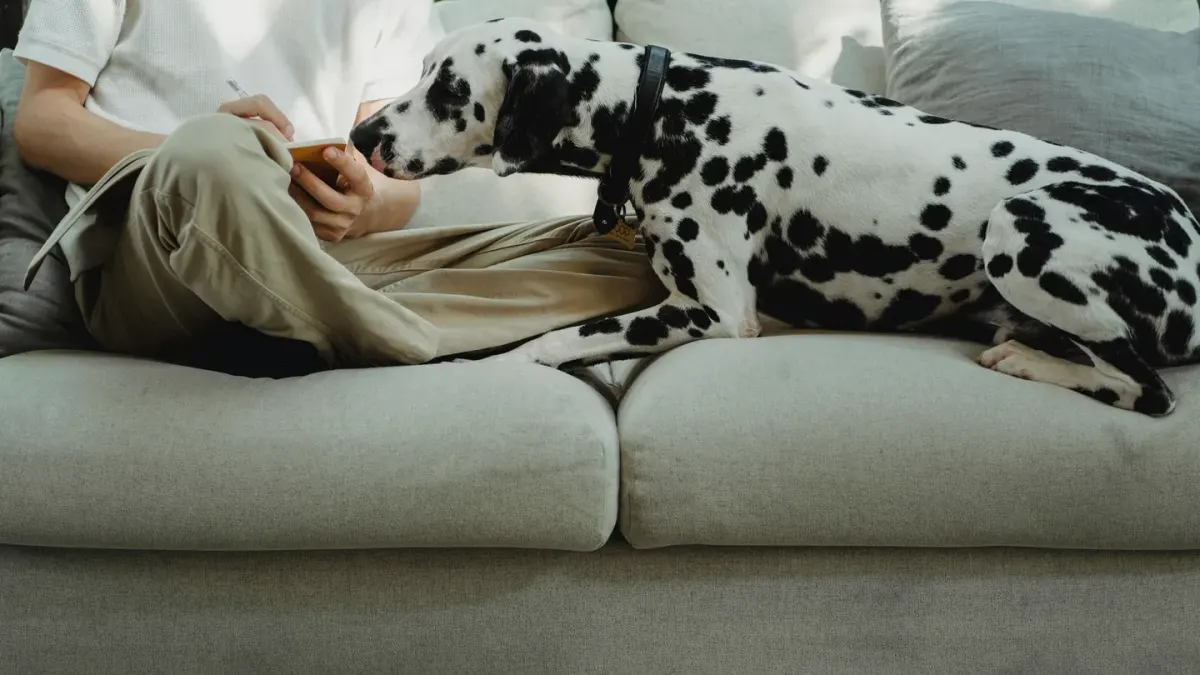
Puppies compete with littermates for food from the moment they’re weaned, usually around three to four weeks old, and that competition doesn’t switch off the day a puppy goes home at eight or nine weeks. A young puppy who eats faster, angles her body over the bowl, or gives a soft grumble when a hand reaches in isn’t showing a behavioral disorder — she’s showing a normal, unlearned response that most puppies carry for at least the first few months.
What happens next depends heavily on how owners respond. Puppies handled calmly around food, without repeated hand-in-bowl testing, generally settle into confident, relaxed eaters. Puppies whose owners inadvertently rehearse the guarding response — more on that below — can go the other direction fast. This is also the stage where guarding questions tend to overlap with general mouthiness; if it’s showing up alongside typical puppy nipping, How to Stop Puppy Biting and Mouthing covers the broader picture of managing a puppy’s mouth around people.
Adolescence: Where a Habit Can Harden
I’ve also seen the approach that backfires. One owner, coached by an old training book, started reaching into her dog’s bowl mid-meal every day to “prove” the food was hers — a classic dominance-style test. By day 10, the dog’s low growl had escalated to a hard snap that grazed the owner’s hand. Nothing about the dog’s temperament had changed; the training had simply taught her that hands near the bowl predicted a fight worth winning. It’s a pattern I see often enough to warn against by name: repeated hand-in-bowl tests don’t build trust, they build a rehearsed defensive reflex, and they tend to make a mild, manageable guarder measurably worse within days, not months.
Adolescent dogs — roughly six months to two years, depending on breed and size — are also testing which behaviors actually work. If stiffening over the bowl reliably makes a hand retreat, that dog has just learned a functional strategy, and functional strategies get repeated. This is the stage where mild puppy wariness either fades because it stopped being necessary, or consolidates into a real habit because it kept working. Expect this window to shape the pattern you’re living with at three years old more than the puppy stage itself does.
Reading the Warning Signs at Mealtime
Dogs rarely go from relaxed to biting with no warning; they move through an escalation sequence. A typical pattern looks like this: the dog freezes mid-chew, the eyes go hard and show more white than usual (sometimes called “whale eye”), the body stiffens over the bowl, a low growl follows, and only after those earlier signals are ignored does a snap or bite happen. Recognizing the early rungs — the freeze, the whale eye, the stiffening — matters more than reacting to the growl, because the growl is often the fourth or fifth signal, not the first.
Owners sometimes read early stiffening as general suspicion or crankiness rather than food guarding specifically, which is part of why it’s easy to misread. The same escalation pattern shows up around toys, resting spots, and handling — it’s worth comparing notes with Why Does My Dog Growl When I Pet Him? if the growling isn’t limited to mealtimes.
Adulthood: What a Settled Pattern Looks Like
By the time a dog is fully mature, guarding behavior has usually settled into a recognizable pattern — mild, moderate, or more serious — and it tends to stay fairly consistent unless something changes in the household or the dog’s health. A settled, mild pattern might look like a dog who tenses slightly if a stranger’s hand reaches in but relaxes instantly once the food stays put, or one who eats faster when another dog walks by but shows no guarding toward people at all. That’s usually manageable with basic household rules: feed dogs separately, keep young children away from a working bowl, and don’t use the bowl as a testing ground. A moderate or more serious pattern — hard freezing, repeated growling, snapping that makes contact — deserves a structured plan, ideally with a certified trainer or veterinary behaviorist, rather than management alone.
When Guarding Is a Symptom, Not a Personality Trait
Then there’s the edge case that changes the whole plan: an eleven-year-old dog with no history of guarding who suddenly starts snapping over her bowl. In dogs that age, new-onset guarding is worth treating as a medical question before a behavioral one — dental pain, osteoarthritis, or early cognitive change can all make a previously easygoing dog defensive around anything that requires bending, chewing, or competing for a resource. Retraining protocols built for a healthy young dog can make an older, painful dog worse, because they ask her to tolerate more handling around food right when handling itself may be the trigger.
New, sudden guarding in a senior dog deserves a veterinary exam before a training plan. That’s the one scenario where I always push the medical workup ahead of the behavior protocol.
New guarding in a dog with no history of it is simply different from a lifelong pattern. Pain changes how a dog tolerates any interaction near a resource, and it’s one of the more common reasons a previously relaxed adult or senior dog starts guarding out of nowhere.
What Changes in the First Few Weeks of Retraining
For a dog with an established but mild-to-moderate pattern, the retraining goal isn’t to stop the guarding by force — it’s to change what a hand near the bowl predicts. Trading up (offering something better than what’s in the bowl, then giving the original food back), hand-feeding part of a meal, and feeding at a distance from other pets are the tools I reach for most often, and they tend to show measurable change within two to three weeks of consistent practice, not overnight.
Reaching into the bowl to test a dog does not build trust; it builds rehearsal of a defensive response, and it’s the single most common mistake I see undone in my own retraining plans. Progress at this stage is usually gradual: less stiffening first, then a softer response to a hand at a distance, and only later, comfort with closer contact.
The Real Evidence Behind Calming Ingredients
Owners managing a guarding dog often ask about calming supplements, and it’s worth being precise about what the research actually supports. Chamomile has a long history of traditional use for relaxation, and a 2026 review in Biomedicines found pharmacological support for that use in some species — though as the reviewers note, “for the remaining species, evidence is derived mainly from preclinical studies or traditional use,” which includes dogs.
Ashwagandha has a somewhat deeper human clinical record. A review in Cureus covering multiple randomized controlled trials concluded that ashwagandha has “a moderate positive impact on stress reduction and cognitive performance” in the populations studied. L-theanine’s picture is more mixed than marketing usually suggests — a large meta-analysis in Molecular Psychiatry found inconsistent effects across trials, “except for one study on psychotic anxiety (SMD = 0.54; 400 mg/day for 8 weeks).”
None of that is dog-specific behavior research, and none of it replaces training. I think of calming ingredients as something that may help support a lower baseline stress level during a retraining window, not a fix for guarding on their own.
How This Fits With Other Behaviors Owners Misread
Food bowl guarding gets lumped in with “dominance” more than almost any other behavior I see, and that framing usually pushes owners toward exactly the wrong response — more confrontation, not less. The same kind of misreading shows up elsewhere. Mounting behavior gets labeled dominance when it’s frequently about arousal or excitement instead, a distinction covered in Is Humping a Dominance Behavior or Just Excitement?. Reactive lunging on leash gets called aggression when it’s often frustration at being blocked, which Barrier Frustration vs Aggression: What’s the Difference? breaks down in more detail. Guarding deserves the same nuance: it’s a communication strategy around a specific resource, not a referendum on who’s in charge of the household.
Where I Land, and Why I Don’t Wait to Intervene
Here’s my standing recommendation, and I give some version of it in nearly every appointment where this comes up: treat any consistent stiffening or growling around the food bowl — in a puppy or a young dog — as a training conversation to start that week, not a phase to monitor. The most common counterargument I hear is some version of “leave it alone, she’ll grow out of it,” and there’s a kernel of truth in it; plenty of mild puppy wariness fades on its own without any intervention at all. But I’ve watched too many mild, manageable cases consolidate into a genuinely serious adult pattern during exactly that waiting period, because every ignored growl that successfully pushes a hand away is a small rehearsal of the same strategy. Early, low-key trade-up training costs almost nothing and rarely makes a mild guarder worse; waiting costs nothing if you’re right about the phase, and a great deal if you’re not.
What I expect for most owners who start early: a calmer mealtime within a few weeks, a dog who no longer needs to be managed around food, and one less thing to watch for as she ages into adulthood. Individual dogs vary quite a bit in temperament and history, so your timeline may look different from a textbook one — but the direction of travel, with consistent handling, is almost always the same.
Frequently asked questions
Is it normal for a dog to growl while guarding his food bowl?
Mild stiffening or a single low growl during meals is common, especially in puppies and adolescent dogs, and doesn't by itself make a dog "aggressive." What matters more is whether the dog relaxes quickly once the hand withdraws and whether the behavior is holding steady or escalating over time.
Should I keep taking my dog's bowl away to stop guarding?
No. Repeatedly reaching into or removing the bowl mid-meal as a "dominance test" tends to teach a dog that hands near food predict a fight worth having, and it can turn mild wariness into a real bite risk within days.
When does food bowl guarding need professional help?
If your dog freezes hard, growls repeatedly, snaps, or has ever made contact with a bite, it's time for a certified trainer or veterinary behaviorist. New guarding that appears suddenly in an older dog also warrants a veterinary exam first, in case pain is driving it.
Can calming supplements fix food bowl guarding?
Ingredients like chamomile, ashwagandha, and L-theanine may help support a calmer baseline during a retraining window, but the underlying evidence is largely human- or general-species research, not dog behavior studies, and none of it substitutes for structured training.
Sources
- Wild Flora Species from Romania with Anxiolytic and Antidepressant Potential: A Global Perspective—Narrative Review — Biomedicines
- Ashwagandha as an Adaptogenic Herb: A Comprehensive Review of Immunological and Neurological Effects — Cureus
- Cognitive and affective effects of L-Theanine: a systematic review and meta-analysis of 31 randomized trials — Molecular Psychiatry