On this page
Quick-decision checklist — read this first, then the reasoning below:
- Dog is stiff after rest but moves fine once warmed up → start with short, flat walks.
- Dog yelps, sits down mid-walk, or won’t bear weight on one leg → prioritize swimming or water treadmill first.
- Dog is overweight on top of arthritis → swimming reduces joint load while you also fix the weight through diet.
- Dog is anxious about water or has never swum → don’t force it; a slow, consistent walking plan is still valid.
- Dog has a cardiac or respiratory condition → clear swimming with your vet before starting; walking is usually the safer default.
- You have access to a canine rehab pool or hydrotherapy center → use it 1–2x/week alongside, not instead of, ground exercise.
I’ve had this conversation more times than I can count, usually in an exam room with an owner holding a leash and looking a little defeated. A twelve-year-old Labrador named Duke comes to mind — sixty-eight pounds, hip dysplasia diagnosed years earlier, and an owner who’d been told by three different people to “just swim him” or “just keep walking him,” as if the two were interchangeable. They aren’t. Duke’s problem, when we worked through it, wasn’t a lack of exercise. It was that his morning walks were loading a hip that hadn’t warmed up yet, and by the third block he was hopping. We didn’t abandon walking. We shortened it, moved it later in the morning after he’d been up and moving around the house, and added two weekly sessions in a heated therapy pool. Within about six weeks his owner noticed he was initiating play again in the evenings, which he’d stopped doing months earlier.
Why the two exercises solve different problems
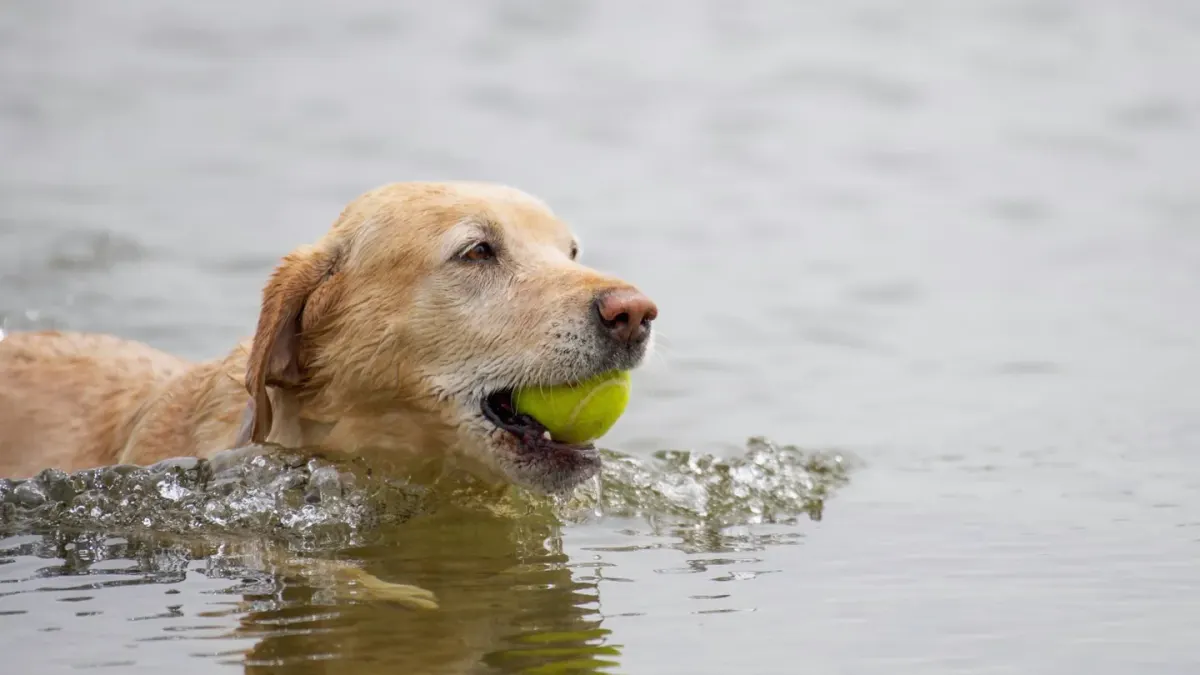
Walking is weight-bearing. That’s exactly what makes it useful and exactly what makes it risky for a dog with joint pain — the muscle around a hip or knee only strengthens under load, but that same load is what an inflamed joint resents. Swimming removes most of that load. Buoyancy takes a large share of body weight off the limbs, which is why water work is a staple of veterinary rehab for dogs recovering from surgery or living with chronic arthritis. The tradeoff is that swimming builds cardiovascular fitness and some muscle tone, but it doesn’t load bone and connective tissue the way ground exercise does, so it’s not a full substitute for walking over the long run.
If you’re trying to decide which one your dog needs first, ask what’s failing right now: joint pain during weight-bearing, or general deconditioning from months of reduced activity. Those call for different starting points, even though most arthritic dogs eventually need both.
What the ingredient science can and can’t tell you
Exercise choices don’t happen in isolation — most owners managing canine arthritis are also looking at joint supplements, and it’s worth being precise about what that research actually shows, because it’s easy to overstate. Chondroitin has been studied for its role in joint tissue: research summarized in Frontiers in Veterinary Science describes chondroitin as supporting “healthy synovial fluid homeostasis.” Glucosamine HCl has a longer research history, and a review in the Journal of Veterinary Medical Science notes that glucosamine can “prevent experimentally induced cartilage degradation in vitro” — an in-vitro finding, not a guarantee of what happens in a moving joint. Green-lipped mussel has also drawn interest for its anti-inflammatory compounds; a study in Nutrients found that mussel-derived oil extracts “alleviated paw swelling in rats and reduced serum levels of rheumatoid factor (RF), anti-cyclic citrullinated peptide (anti-CCP) antibody, and pro-inflammatory cytokines such as TNF-α and IL-17” — again, an animal model, not a clinical trial in pet dogs. I weigh these findings as reasonable support for a joint-health plan, not as a reason to skip the exercise conversation. No supplement replaces appropriately dosed movement, and none of this research licenses a claim that any product will cure or reverse arthritis in your own dog.
Building a realistic weekly plan
For most arthritic dogs, I land on a mixed plan rather than picking a single winner, and here’s roughly how I structure it: short, flat walks most days, timed after the dog has had a chance to loosen up rather than first thing out of bed, plus one or two swimming or water-treadmill sessions a week if access allows. Dogs who can’t tolerate water at all still do better on frequent short walks than on one long walk — five ten-minute outings beat one fifty-minute march for a stiff joint. If you’re weighing indoor options against outdoor ones for a dog whose weather tolerance is limited, our guide to Dog Treadmill vs. Outdoor Walking covers how a treadmill compares for building fitness without adding joint stress. And if you’re simply unsure how much ground exercise is appropriate for your dog’s age and size, How Far Can a Dog Walk or Hike in a Day? is a useful starting point before you scale anything up.
There’s a scene that comes back to me often — an owner in her seventies with a fourteen-year-old Cavalier King Charles Spaniel, both of them slower than they used to be, standing at the edge of a community pool built for dog rehab. She was nervous the dog would panic in the water. He didn’t. He paddled a slow, careful circle with a flotation vest on, and she laughed for what she said was the first time in weeks. That’s not a study result and I won’t pretend it is one. But it’s the kind of shift — a dog moving without wincing, an owner remembering what her dog used to look like — that tells you the plan is working better than any single metric would.
The bottom line
Don’t ask which exercise is better in the abstract. Ask what your dog’s joint needs this month, and build from there — walking for the muscle and bone, swimming for the days the joint needs a break, and a supplement plan grounded in real evidence rather than marketing claims. Individual dogs vary widely in how they tolerate both, so loop in your vet before making a big change, especially if there’s a heart or lung condition in the picture. While you’re auditing your dog’s routine, it’s also worth double-checking the everyday hazards around the house — foods like grapes and onions are far more dangerous than most owners realize, and our guides on why grapes are toxic to dogs and why onions aren’t safe in any amount are worth a read if you haven’t already.
Frequently asked questions
Is swimming better than walking for a dog with arthritis?
Neither is universally better — swimming reduces joint load and is gentler during flare-ups, while walking builds the muscle and bone strength that support the joint long-term. Most arthritic dogs benefit from a mix of both.
How often should an arthritic dog swim?
One to two sessions a week alongside daily short walks is a reasonable starting point for many dogs, but tolerance varies, so build up gradually and watch how your dog recovers afterward.
Can joint supplements replace exercise for an arthritic dog?
No. Ingredients like glucosamine, chondroitin, and green-lipped mussel have research support for joint health, but they're a complement to an appropriate exercise plan, not a substitute for it.
Sources
- Chondroitin sulfate and joint homeostasis review — Frontiers in Veterinary Science
- Glucosamine HCl and cartilage degradation review — Journal of Veterinary Medical Science
- Green-lipped mussel oil in an arthritis model — Nutrients