
A client of mine brought in a seven-year-old Labrador, forty pounds overweight, whose owners had bought a treadmill the winter before because their neighborhood had no sidewalks and the nearest trail flooded every spring. Six months in, the dog was walking three miles a day on the belt and hadn’t lost a pound. Nothing was wrong with the machine. The problem was that the dog never had to negotiate a curb, adjust to gravel, or slow down to sniff something interesting — and all of that low-level variability is part of what makes outdoor walking metabolically and orthopedically demanding in a way flat, even-paced belt walking usually isn’t.
That case is the reason I tell owners to think of a treadmill as a conditioning tool with a narrow job, not a full replacement for a walk.
What a treadmill actually standardizes. A treadmill controls three variables well: speed, incline, and duration. That consistency is genuinely useful for a dog recovering from an orthopedic procedure who needs a fixed, repeatable gait pattern, or for an owner in a climate where outdoor exercise is dangerous for weeks at a time — extreme heat, ice, wildfire smoke. Rehab practices use underwater and land treadmills for exactly this reason: the environment is controllable, so a clinician can isolate stride length or weight-bearing changes without the confounding effect of terrain.
Where outdoor walking still wins. Outdoor walking asks more of a dog’s proprioceptive system and more of its cardiovascular system per minute of effort, mostly because the surface never stays the same for more than a few strides. Grass, dirt, concrete, and gravel each load paws, joints, and stabilizing muscles differently, and a dog constantly making small postural adjustments burns more energy than one moving at a fixed cadence on a flat belt. Outdoor walks also come with unpredictable stops, starts, and pace changes — sniffing, greeting another dog, climbing a curb — that build a kind of functional strength a treadmill session doesn’t replicate. If the goal is general fitness and weight management rather than a specific rehab protocol, the outdoor walk is usually doing more work per mile.
There’s also a practical planning question underneath all of this: how far a given dog should realistically be walking in a day. Breed, age, and conditioning all shape that number, and our guide on how far a dog can walk or hike in a day is a reasonable starting point before you decide whether a treadmill needs to supplement or replace those walks.
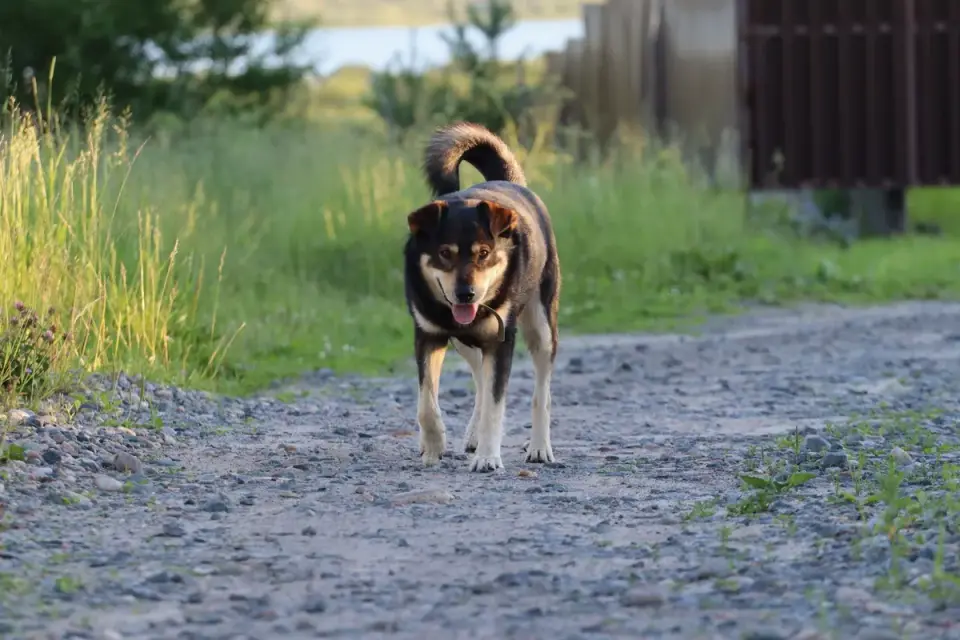
I’ve watched this play out differently with an eleven-year-old Australian Shepherd whose owner switched almost entirely to treadmill walking after the dog started slipping on hardwood floors at home. The owner’s logic was sound — a rubber belt is safer footing than hardwood — but after two months the dog’s gait on grass had gotten noticeably more tentative, not less, because the dog had lost practice negotiating uneven ground. We didn’t abandon the treadmill; we used it for the days when weather or the owner’s schedule made an outdoor walk impossible, and kept at least four short outdoor walks a week on grass and packed dirt specifically to keep that proprioceptive skill from atrophying. Within six weeks, the owner reported the dog was navigating the yard’s slight slope with more confidence again.
Recovery and joint support between sessions. Whichever the dog is doing more of, the tissue that absorbs the impact still needs to recover, and this is where I think owners underrate what a joint supplement can realistically contribute. Glucosamine and chondroitin are among the most studied joint-support ingredients for dogs, and the evidence base, while imperfect, is meaningful: chondroitin has been shown to support healthy synovial fluid homeostasis, according to a 2026 study in Frontiers in Veterinary Science, and glucosamine HCl has been found in laboratory research to help prevent experimentally induced cartilage degradation, per a review in the Journal of Veterinary Medical Science. Green-lipped mussel powder has separately shown anti-inflammatory activity in animal models — reducing paw swelling and markers like TNF-α and IL-17 — in research published in Nutrients.
None of that means a supplement replaces good exercise programming, and I’m careful not to oversell it to clients. What it does mean is that a dog doing more variable, higher-load work outdoors — or a dog transitioning off strict treadmill rehab back onto uneven ground — may benefit from that additional joint support while the connective tissue adapts. I weigh it as one input among several: conditioning, surface, body weight, and age all matter more than any single ingredient, but for a dog with early joint changes, it’s a reasonable piece of the plan to discuss with your veterinarian rather than dismiss outright.
Body condition matters just as much here. A dog carrying extra weight puts more force through every joint on every stride, whether that stride happens on a belt or a sidewalk, which is part of why the Labrador case above didn’t resolve until we changed the diet plan alongside the exercise routine. If you’re building an exercise plan for a dog in an apartment with limited outdoor access, our guide to best dog breeds for apartment living covers some of the space and activity tradeoffs that make a treadmill more or less necessary in the first place.
Matching the tool to the dog. For a healthy adult dog with reasonable access to a yard, park, or sidewalk, I generally recommend outdoor walking as the primary exercise and treating a treadmill as a backup for bad weather or scheduling gaps — not the other way around. For a dog in structured rehab, recovering from surgery, or living somewhere true outdoor access is genuinely limited for long stretches of the year, a treadmill session done at a vet- or rehab-specialist-recommended pace and incline is a legitimate primary tool, and outdoor time can be added back gradually as the dog’s tolerance improves.
The Australian Shepherd from that case is back to daily grass walks now, treadmill reserved for icy mornings. Which side of that split makes sense for your dog probably depends less on the machine than on what kind of movement their joints and nervous system actually need practice with this year.
Frequently asked questions
Is a treadmill or outdoor walking better for weight loss in dogs?
Outdoor walking generally burns more energy per mile because uneven terrain and pace changes demand more muscular and cardiovascular effort, but a treadmill can be a consistent supplement when outdoor time is limited.
Can treadmill walking help a dog recovering from joint surgery?
Yes — controlled treadmill sessions are commonly used in veterinary rehab because they let a clinician standardize speed, incline, and duration during recovery. Talk to your vet or a certified rehab specialist about an appropriate protocol.
Do joint supplements help dogs that walk or run a lot?
Ingredients like glucosamine, chondroitin, and green-lipped mussel have evidence supporting joint and cartilage health, and may be a reasonable addition for active or aging dogs, but they work alongside good conditioning and body-weight management, not instead of them.
Sources
- Protective effects of turmerosaccharides rich extract of Curcuma longa L. in osteoarthritic dogs — Frontiers in Veterinary Science
- Glucosamine HCl and cartilage degradation — Journal of Veterinary Medical Science
- Blue Mussel Oil, Green Mussel Oil, and Ketone Oil in Adjuvant-Induced Arthritis — Nutrients