
On this page
A 10-week-old mini poodle named Daisy came in for her second round of vaccines, and her owner asked me the question I hear almost every week: pads or outside, and can we just do both? I told her what I tell most clients — pick one primary surface and commit to it, because the dogs who struggle most at five and six months are usually the ones who got mixed signals early. Daisy’s owner worked from a third-floor walk-up and had been putting a pad by the door “just in case.” Within two weeks, Daisy was reliably choosing the pad over the actual door, even when someone was standing right there ready to take her out. We spent the next month unwinding that preference, moving the pad closer to the exit a few feet at a time until it sat outside on the balcony, then eventually disappeared. It worked, but it took twice as long as it would have if we’d started outside on day one.
Why the surface a puppy learns first matters more than the schedule
Puppies don’t generalize “bathroom” the way adult dogs do — they learn a specific substrate, texture, and location, and they default back to it under stress or when access is delayed. That’s the core problem with puppy pads: absorbent pad material feels a lot like the bath mat, the rug by the couch, or a dropped towel, and a puppy who’s been rewarded for using one texture will often test the others. According to Housetraining Dogs: Puppy Potty Pad and Paper Training: AKC, pad training can work as a bridge for owners who genuinely cannot get a young, unvaccinated puppy outside frequently enough, but it also warns that transitioning off pads later is its own project — one that can take as long as the original training did.
Bladder physiology is the other half of the equation, and it’s not optional. A commonly used rule of thumb is that a puppy can typically hold their bladder for about one hour per month of age, plus one — so a two-month-old puppy is realistically good for two to three hours, not eight. That math is why so many apartment owners reach for pads in the first place: the walk to the elevator, lobby, and sidewalk simply doesn’t happen fast enough at 3 a.m. That’s a legitimate logistics problem, and I don’t dismiss it. But it’s a different problem than “which method trains faster,” and conflating the two is where a lot of plans go sideways.
Where pads genuinely earn their place
I’m not anti-pad. Preventive Vet makes a case I largely agree with: pads can be the right call for young puppies who haven’t completed their vaccine series and shouldn’t be on public ground yet, for toy breeds with genuinely small bladders and frequent needs, for owners managing a long workday with no one able to let the puppy out midday, and for senior or mobility-limited dogs who can’t always make it to the door in time. None of those are training failures — they’re real-world constraints, and a pad or an indoor turf box is a reasonable accommodation.
Where pads cause trouble is when they’re used as a permanent convenience for a healthy, mobile puppy in a house with yard access, purely to avoid a few extra trips outside during the puppy’s first two months. That’s the scenario where the substrate confusion I described with Daisy tends to show up, and it’s avoidable.
The transition problem nobody mentions until it’s already happening
Here’s the part that surprises new owners most: switching a pad-trained puppy to outdoor-only isn’t a light switch, it’s a fade. You move the pad an inch or two closer to the door every few days, then onto the porch, then off the porch entirely, rewarding heavily at each stage so the puppy doesn’t just hold it or find a new indoor spot instead. Bond Vet notes that some dogs never fully make the switch and continue offering indoor elimination as an option well into adulthood, particularly if the pad was available for more than a few months. If you know from the start that outdoor-only is your long-term goal, skipping the pad phase entirely — even if it means more 2 a.m. trips for the first few weeks — is usually the shorter road.
I’ve watched this play out with a lot of different breeds over the years, but one case stands out. A family with a 14-week-old cavapoo had used pads since bringing him home at eight weeks because their yard wasn’t fenced yet. Once the fence went in, they tried to switch cold turkey, and the puppy started having accidents next to the pad’s old location on the kitchen floor even after the pad itself was gone — the spot, not just the object, had become the cue. It took about three weeks of consistent redirection and a strict outdoor schedule anchored to meals and naps before that stopped completely. That’s a fairly typical timeline for un-learning a pad habit, and it’s worth knowing upfront so it doesn’t feel like the training has failed.
What actually predicts success either way
Regardless of which surface you choose, the puppies who house-train fastest are the ones on a tight, predictable schedule tied to biological triggers — right after waking, right after eating, right after a play session — rather than an arbitrary clock. Puppy Potty Training Schedule: A Timeline for Housebreaking Your Puppy: AKC lays out a general timeline where most puppies are largely reliable by five to six months with a consistent routine, though individual dogs vary quite a bit based on breed, size, and how consistent the household actually is day to day. Small-breed puppies in particular tend to take a little longer simply because their bladders are smaller relative to how often they eat and drink. If you want a fuller week-by-week framework, our guide on a puppy potty-training schedule that works walks through how to build that routine around your own puppy’s age, and how to potty train a puppy covers the reinforcement and timing piece in more depth.
The other predictor is how you mark success in the moment. A puppy who’s rewarded within a second or two of finishing outside learns the connection far faster than one praised after walking back inside — timing there matters as much as location does, and it’s the same principle we cover in clicker vs. verbal marker word for behavior training generally.
What I actually tell owners
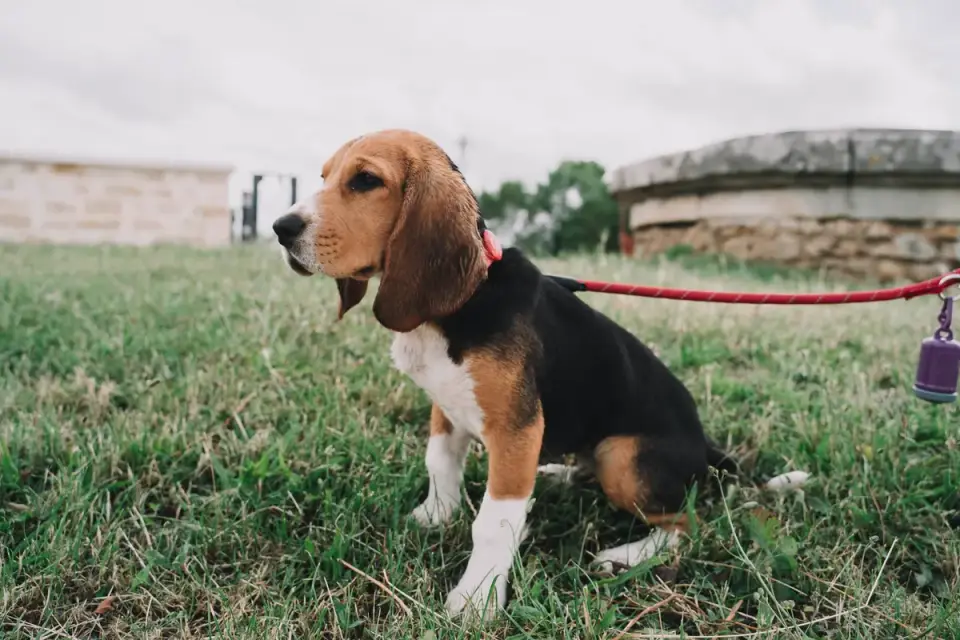
If a puppy can physically get outside on a schedule that matches their real bladder capacity — which for most healthy puppies past their first vaccine round means every two to three hours during the day — I recommend skipping pads and going outside from day one. It’s a rougher first two weeks, especially with the overnight wakeups, but it avoids the substrate-confusion problem entirely and tends to produce a reliably house-trained dog faster overall. If your circumstances genuinely don’t allow that — a high-rise with no fast elevator access, an unvaccinated puppy, a toy breed with a very small bladder, or a household that’s out of the house for long unbroken stretches — pads are a legitimate tool, not a failure, and AKC offers a workable path to phase them out once your circumstances change. Whichever you choose, individual puppies vary in how quickly they catch on, and a dog who’s still having regular accidents well past six months of age, or who suddenly regresses after being reliable, is worth a conversation with your own veterinarian to rule out a medical cause before assuming it’s a training issue.

Frequently asked questions
Is it bad to use both puppy pads and outdoor training at the same time?
It can slow progress. Puppies learn a specific surface and location for elimination, and offering both at once often creates confusion that takes longer to resolve than committing to one method from the start.
How long does it take to switch a pad-trained puppy to going outside?
It varies by dog, but a gradual fade — moving the pad closer to the door over days or weeks — commonly takes several weeks and sometimes longer if the pad was used for months.
At what age should a puppy be reliably house-trained?
Many puppies are largely reliable by five to six months with a consistent schedule, though small breeds and individual dogs can take longer.
Sources
- Housetraining Dogs: Puppy Potty Pad and Paper Training — American Kennel Club
- Puppy Potty Training Schedule: A Timeline for Housebreaking Your Puppy — American Kennel Club
- Pee Pad Training: Is It a Good Idea? — Preventive Vet
- Pee Pads for Puppies: The Pros and Cons — Bond Vet