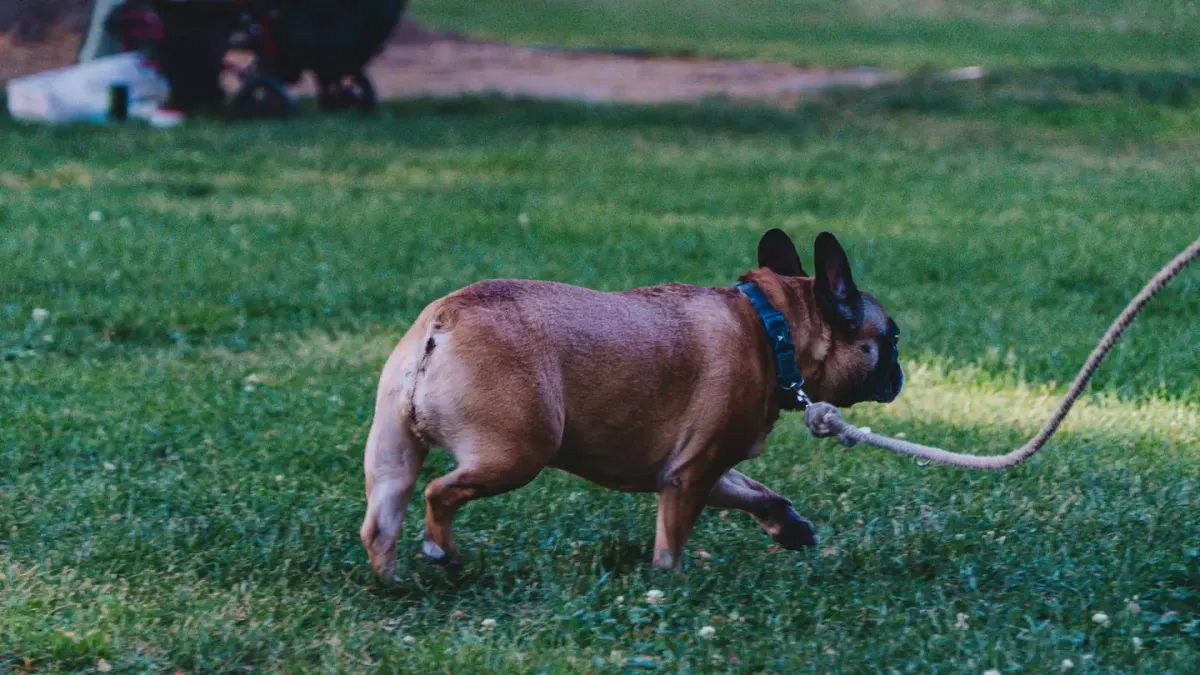
On this page
A client once came in holding her hand oddly, fingers wrapped in gauze, and it took me a minute to connect the dots: a rope burn from a retractable leash cord, sliced across her palm when her beagle bolted after a squirrel mid-walk. She wasn’t careless. She’d used that leash for two years without a problem, until the one afternoon it mattered. I’ve seen versions of this story enough times that when clients ask me about “the long clip-and-reel leash” versus a long line for training, I don’t equivocate. They are not the same tool, and treating them as interchangeable is where the trouble starts.
The mechanism: why a cord under tension behaves differently than a line
A retractable leash is a thin cord or webbing strap wound on a spring-loaded reel inside a plastic handle. The braking mechanism only engages when the owner presses a button or the cord reaches full extension — until then, the dog is moving on a variable, often unpredictable length of line with almost no tactile feedback for the handler. A long line, by contrast, is a fixed-length lead, usually 15 to 50 feet of flat nylon, biothane, or climbing-style rope, held in loops or let out by hand. The dog’s movement is continuous and readable through the line itself; there’s no reel mechanism translating a sudden pull into a thin, fast-moving cord.
That difference in mechanism is what shows up in emergency rooms. A dog leash-related injuries study using national U.S. injury surveillance data found leashes were tied to an estimated 356,746 emergency department visits over the study period, split mostly between pulling incidents and trip-or-tangle events, as reported in ScienceDirect: Dog leash-related injuries treated at emergency departments. Retractable cords concentrate force onto a narrow contact surface, which is exactly the geometry that produces rope burns, lacerations, and — in the worst documented cases — finger amputations, a pattern PetMD has cataloged directly. A long line spreads that same force over a wider, flatter surface and gives the handler continuous slack to manage rather than a sudden unspooling.
Where a long line actually earns its keep
Long lines exist to solve one specific training problem: distance without loss of control. Recall work, sniff walks in open fields, and decompression time for a dog who needs space from triggers all require the dog to move 20, 30, even 50 feet away and still be retrievable. A flat webbing or biothane long line clipped to a back-clip harness lets that happen because the handler can drop it, gather it, or step on it without a mechanical reel between hand and dog. If the dog hits the end at a run, the stopping force lands on the chest and shoulders through the harness rather than the neck, which matters more than most owners assume.
The tradeoff is real: a long line pools, tangles in brush, and takes two hands to manage well, especially in the first few weeks. Nylon versions can burn a bare hand if a dog lunges and the line runs fast through your palm, so I tell owners to glove up or switch to biothane once they’ve had that lesson once. It’s a training tool, not a leave-it-clipped-on-during-a-crowded-sidewalk-walk tool — and that distinction is where the retractable leash still finds a legitimate, narrow lane.
The narrow case for a retractable leash — and why it doesn’t extend to training
I’m not going to tell owners the retractable leash has zero place. On a quiet, obstacle-free trail, with a dog who has rock-solid loose-leash manners and no interest in wildlife, the extra few feet of roaming room can be pleasant for both of them. What I push back on is using it as a training tool, because the mechanism works against the goal. Training a recall, a check-in, or a controlled approach to another dog all depend on the handler being able to shorten the line instantly and predictably. A retractable leash’s brake is a button press away, and by the time a thumb finds it, a fast-moving dog has often already covered the gap. Most veterinarians steer clients away from retractables for exactly this control gap, a stance Preventive Vet lays out well, and it lines up with what I see clinically: the injuries I treat cluster around retractables, not fixed lines.
In my practice, the dogs who get hurt on retractable leashes are rarely the reactive ones everyone worries about — they’re the friendly, food-motivated dogs who dart six extra feet toward a dropped sandwich before the reel even registers slack. I had a four-year-old Labrador mix, a sturdy 68-pound dog, whose owner described the exact moment: cord fully extended, dog spotted a squirrel on a fall afternoon, and the sudden jerk against a flat collar left him head-tilting and reluctant to be touched near the throat for nearly a week. Nothing structural on imaging, thankfully, just soft tissue strain. That’s the pattern that changes my recommendation from “use caution” to “use a different tool” for anyone doing actual training work, whether that’s potty training routines that depend on predictable leash handling or recall drills that need instant slack control.
What I actually tell owners
If the goal is training — recall, distance work, decompression sniff walks, even just building the foundation habits from a puppy’s early routine — a long line on a harness is the tool that matches the job. If the goal is a relaxed stroll with a dog who already has solid leash skills, a standard fixed leash is still the simplest, safest default, and a retractable leash is, at best, an occasional convenience for that one narrow scenario, never the training tool.
Bottom line: reach for a long line when you’re actively training distance or recall, and leave the retractable leash off the gear list until the dog’s manners no longer need active management.
Frequently asked questions
Is a long line safe to use around other dogs?
Only with care — a dropped or dragging long line can tangle around another dog's legs or a passerby, so keep it gathered and supervised in busier areas rather than letting it run loose.
What length long line should I start with?
Most trainers start owners on 15–20 feet until they're comfortable managing slack, then move up to 30 feet or more for open-field recall work.
Can I use a retractable leash for a puppy?
It's not the best choice for a puppy who's still learning leash manners, since the variable tension and delayed brake make it hard to teach a consistent loose-leash habit early on.