On this page
Dex, a three-year-old corgi mix, used to trail his owner Elena from the kitchen to the bathroom to the laundry room, settling against whatever door she’d just closed and letting out a low whine the second the latch clicked. She liked the closeness, at first. Then she started working from a home office and realized she couldn’t take a phone call, refill a water glass, or step into another room without a small dog wedged against her ankle.
To stop your dog from following you everywhere, teach a settle cue and reward distance instead of proximity. That single shift, practiced daily and without drama, is what eventually gave Elena her hallway back — and it’s the same principle behind most independence-training plans, whatever the dog’s age or history.
Why some dogs turn into shadows
Before changing anything, it helps to understand what’s actually driving the behavior. Some dogs follow because following has always been rewarded — a glance, a pat, a treat dropped nearby, all delivered the moment the dog stayed close. Others are bred with a genetic pull toward tracking movement; herding-type dogs in particular often orient hard on the person moving through a space, though that’s a tendency, not a guarantee, and plenty of individual dogs from herding lines are perfectly content napping alone. Boredom and under-exercise push some dogs toward a person simply because the person is the most interesting thing in the room. And for a smaller group, the shadowing is anxiety-driven: the dog isn’t choosing companionship so much as managing unease by staying in visual range.
Not every velcro dog is anxious. Sorting out which category yours falls into shapes how you respond, and it’s worth watching for a week before starting formal training — note whether the following intensifies during specific triggers (a knock at the door, a suitcase coming out) or stays steady no matter what else is going on.
Building distance tolerance the first week
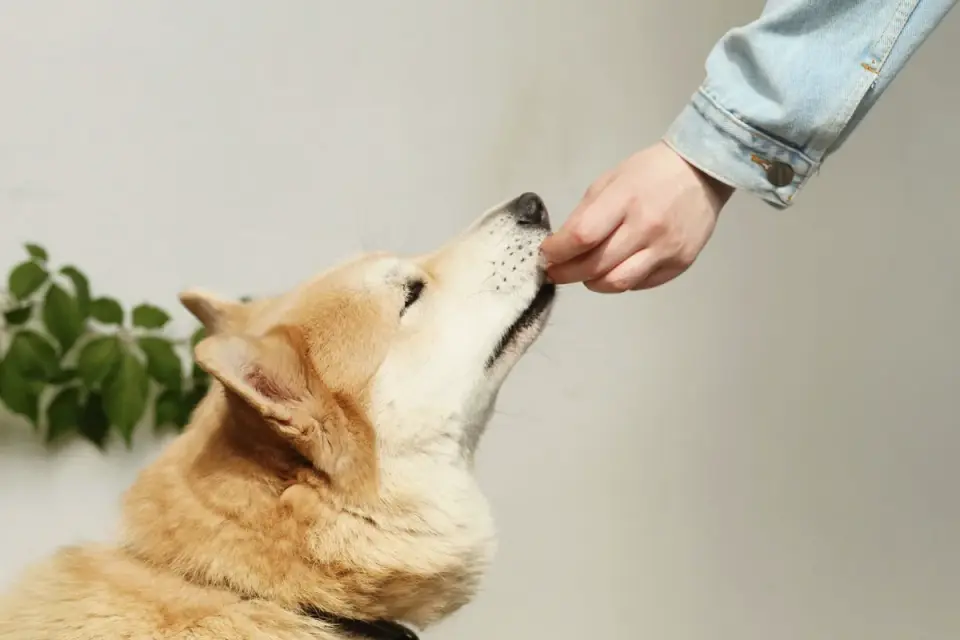
The earliest phase is about proving that distance doesn’t mean abandonment. Start with a mat or bed in a room the dog already likes, and reward calm settling there while you move just a few feet away — to the counter, the doorway, never further than the dog can comfortably tolerate without breaking position. Scatter a few treats on the mat before you step away, then return and reward again before the dog has a chance to get up and follow. Repeat in short sessions rather than one long marathon.
Resist the urge to sneak out unnoticed during this phase. The goal isn’t to trick the dog into not noticing you left — it’s to teach the dog that noticing you left is fine.
Weeks two through four: calm departures and place training
Once a dog will hold a stay for thirty seconds or so with you a room away, start layering in ordinary departures: getting the mail, grabbing laundry, stepping into the garage. Keep goodbyes and hellos boring on purpose — no big buildup, no exuberant reunion — because emotional departures teach the dog that your leaving is a significant event worth reacting to. A place cue, paired with a specific bed or mat the dog associates with calm, gives the dog a job to do besides tracking your footsteps. Extend absences gradually, and if the dog breaks position repeatedly, that’s a signal to shorten the distance or duration again rather than push through.
Progress at this stage is rarely a straight line. Some days go smoothly and others don’t, and that’s normal rather than a sign the plan has failed.
The month mark: generalizing independence around the house
By the time a dog can hold a settle in the living room while you’re in the kitchen, it’s worth testing the same skill in other rooms and with other family members giving the cues, since dogs generalize behavior less readily than people expect. Add in daily exercise and mental enrichment — a sniff walk, a food puzzle, structured play — because a physically and mentally satisfied dog has less restless energy driving it to trail you out of sheer boredom. Rotating who handles feeding, walks, and settle practice also reduces the odds that the dog’s independence gains apply only to one household member.
Where calming support can fit in
For dogs whose following is tangled up with general stress rather than habit, some ingredients have modest supporting evidence as an adjunct to training, never as a replacement for it. A review on Biomedicines notes that for chamomile’s use in anxiety and stress, “for the remaining species, evidence is derived mainly from preclinical studies or traditional use,” which is a fair summary of where the evidence currently stands. Ashwagandha has more clinical backing in people: a systematic review in Cureus “analyzed multiple RCTs and concluded that ashwagandha has a moderate positive impact on stress reduction and cognitive performance.” L-theanine’s picture is more mixed — a review in Molecular Psychiatry found meaningful effects in most studies “except for one study on psychotic anxiety (SMD = 0.54; 400 mg/day for 8 weeks),” underscoring that dosing and study population both matter. None of this substitutes for the behavioral work above, and any supplement decision for a dog should go through your veterinarian first, since doses and interactions differ from the human research.

When constant following signals something more serious
Habit-based shadowing and true separation anxiety can look similar from across the room but need different responses. Watch for panting, drooling, pacing, destructive chewing, or house-soiling that happens specifically when you leave the dog’s sight — even briefly, even within the same house — rather than only during actual departures from the home. If independence training stalls after a few consistent weeks, or the dog shows real panic rather than mild insistence, loop in your veterinarian or a certified behaviorist rather than pushing the plan further on your own. Individual dogs vary enough that what worked for Dex, or for any other dog in a guide like this one, may need real adjustment for yours — and a professional set of eyes is the fastest way to find the right version of the plan.
Frequently asked questions
Is it bad that my dog follows me everywhere?
Not inherently. Plenty of dogs shadow their people out of habit, curiosity, or breed background rather than distress. It becomes worth addressing when it limits your daily life or when the dog seems anxious rather than simply curious.
How long does independence training usually take?
Many owners notice a difference within two to four weeks of consistent daily practice, though timelines vary widely by dog, history, and how gradually distance is increased.
Should I ignore my dog when it follows me?
Ignoring isn't the same as punishing, and it can help, but pairing calm indifference with active rewards for staying on a mat or bed tends to work faster than withdrawal alone.
Can supplements stop velcro behavior on their own?
No. Ingredients like chamomile, ashwagandha, or L-theanine are studied for general stress support, not as a fix for attachment-driven following, and training remains the primary tool.
Sources
- Chamomile and anxiety/stress: evidence review — Biomedicines
- Ashwagandha systematic review of RCTs on stress and cognition — Cureus
- L-theanine and anxiety outcomes across trials — Molecular Psychiatry