On this page
By late July the afternoon pavement stays hot long after sunset, and the usual long walk stops making sense. Last summer I talked through this with an owner of a 5-year-old, 68-pound Labrador mix who paced and whined by 7 p.m. when his neighborhood loop was canceled for the third day in a row. He was not under-exercised in the fitness sense — his weight was steady, his morning walk was intact — he was under-occupied. We mapped a 20-minute indoor circuit instead: hallway recalls, stair-free find-it games, and two-minute tug intervals with rest breaks. By day 10 the owner reported the pacing had faded, not because we replaced the miles, but because we replaced the job the walk had been doing.
That is the decision to make concrete during a heatwave: you are not trying to replicate distance indoors.
When the forecast cancels the walk
Dogs cool primarily by panting, and humid, still air makes that exchange inefficient. Brachycephalic breeds, dark-coated dogs, puppies, seniors, and dogs with extra body condition feel it first. A common question is whether a quick evening walk is still okay, and my answer is to check surfaces, shade, and recovery — hot asphalt, heavy panting that does not settle, or a dog that wants to lie down are all stop signs.
Think in a daily rhythm rather than a single workout. Keep any outdoor relief walk short and shady in early morning, move real activity to air-conditioned space midday, and use the evening for calm sniffing and training. That lifecycle approach protects feet, airways, and joints without letting a high-energy dog unravel.
Trading miles for reps and puzzles
Indoor fitness for dogs is interval fitness: short bouts of controlled movement followed by settle time. Try three to five rounds of 2–3 minutes, with water and a down-stay between rounds.
Good building blocks include nose work in boxes, food puzzles, slow feeder trails, obedience chains, platform stands, cavaletti poles made from broomsticks on books, and gentle tug with clear drop cues. For dogs that love to fetch, roll rather than throw a ball down a carpeted hallway so they do not slam into walls or skid on slick floors.
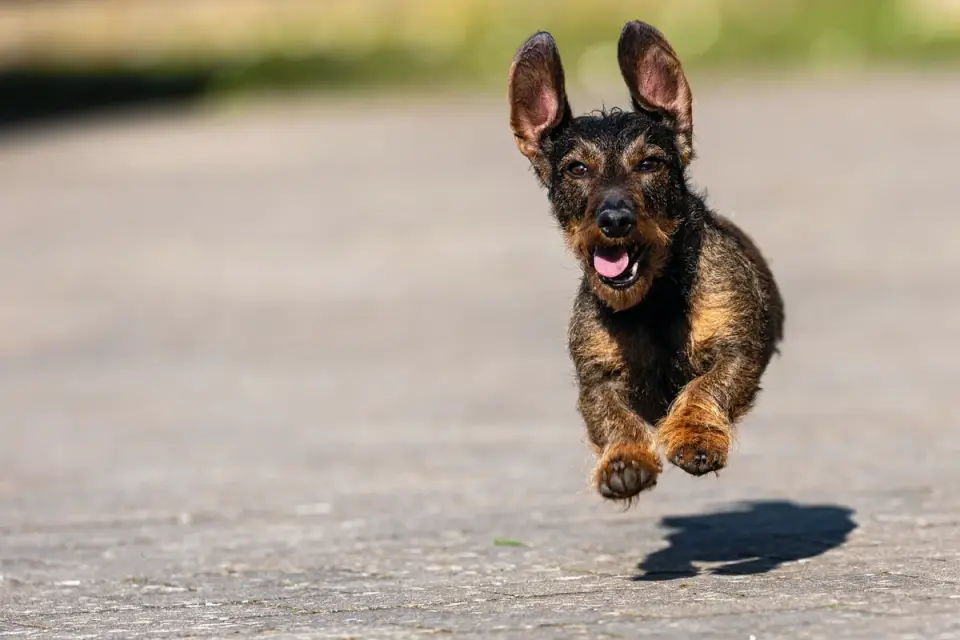
The tradeoff I see owners hit came up with a 3-year-old, 42-pound border collie mix who lived in a second-floor apartment during a week of 100-degree heat. The owner tried to tire her with an hour of nonstop living-room fetch, and three weeks in that pattern the dog was fitter, more aroused, and worse at settling — plus she started short-striding after crashing into a doorframe. We cut fetch to two controlled rolls per set and added search games and mat work. Her evening restlessness eased once effort was paired with thinking, which is the point many indoor plans miss.
Start where your dog is.
What food and supplements can realistically do
Exercise keeps joints moving, and nutrition may help support the tissues behind that movement. That is where I weigh supplement science carefully: food therapy and conditioning do most of the work, while select ingredients may help support mobility and recovery as part of a balanced diet.
Glucosamine and chondroitin are among the most studied joint support ingredients for dogs, according to a veterinary review summarized by Boops Pets Veterinary Review Board — but that source framing matters. I should clarify the primary literature behind that statement, because authority summaries are not trials. In laboratory work, glucosamine has been reported to “prevent experimentally induced cartilage degradation in vitro” in work published in the Journal of Veterinary Medical Science, which tells us about a mechanism in cells, not that a chew prevents arthritis in a living dog.
Chondroitin research points in a similar supportive direction, with one peer-reviewed report describing an effect that “supports healthy synovial fluid homeostasis” in Frontiers in Veterinary Science. Green-lipped mussel is ingredient-literate in a different way, supplying omega-3 fatty acids and glycosaminoglycans studied for joint support; in a rodent model, researchers found that “BMO, GMO, and KO all alleviated paw swelling in rats and reduced serum levels of rheumatoid factor (RF), anti-cyclic citrullinated peptide (anti-CCP) antibody, and pro-inflammatory cytokines such as TNF-α and IL-17” as reported in Nutrients.
The strongest counterargument is fair: none of those lines proves an indoor-exercise supplement will keep a healthy dog sound through a heatwave. I still land on using a complete diet plus, when appropriate, a joint-focused supplement as a low-risk support for mobility and recovery — not as a substitute for weight control, sane surfaces, and rest days. Individual dogs vary, so talk with your own veterinarian about what fits your dog’s age and history.
For more ideas on low-impact mental work, see How to Mentally Tire a Dog That Can’t Exercise and, for dogs that miss their mileage, Dog Treadmill vs. Outdoor Walking: What Actually Builds Fitness and Joint Resilience. If you normally rely on long walks, How Far Can a Dog Walk or Hike in a Day? helps reset expectations until temperatures drop.
The senior dog who changes the plan
Edge cases matter more indoors than owners expect. A 11-year-old, 54-pound Golden Retriever I discussed with an owner did fine with puzzle feeders but started panting heavily after just four minutes of indoor stairs play during a heat advisory, even in air conditioning. The owner worried about fitness loss. We stopped the stairs entirely, switched to flat-surface weight-shifting, cookie stretches, and three short sniff walks on grass after dark, and added extra water stations plus a cooling mat for recovery. By week two the dog settled faster after play, which reminded us that for seniors and arthritic dogs, success is measured by next-morning stiffness and enthusiasm, not minutes logged.
Keep sessions on carpet, yoga mats, or grass. Skip slippery-tile wrestling, repeated jumps off couches, and long stair repetitions.
A heatwave week that actually works
Build the day around cool hours, then layer short wins. Morning: brief relief walk and breakfast from a puzzle. Midday: two indoor circuits with a nap between. Evening: training or Off-Leash Play vs. On-Leash Walks: How to Balance Both for Real Fitness thinking applied indoors — a little controlled movement, a lot of sniffing.
Watch for overheating even inside: roaring panting, drool, glazed eyes, vomiting, or wobbliness mean stop, cool gently, and call your veterinarian. Looking ahead, dogs that keep a heatwave routine of nose work, strength basics, and calm settling often return to outdoor mileage fitter than dogs that either rested completely or drilled frantic indoor fetch every night.
Sources
- Joint Supplements and Nutraceuticals in Dogs — Boops Pets Veterinary Review Board
- Prevent experimentally induced cartilage degradation in vitro — Journal of Veterinary Medical Science
- Supports healthy synovial fluid homeostasis — Frontiers in Veterinary Science
- BMO, GMO, and KO and paw swelling in rats — Nutrients