
Start with the decision in front of you, not the debate. If your dog is healthy, well-conditioned, and in a safe, enclosed space, off-leash play is the faster way to burn energy and build agility. If your dog is a puppy, a senior, overweight, recovering from injury, or you’re anywhere near traffic or an unfenced trail, the leash walk is the safer default. Most dogs need both, on a schedule that respects what each one actually does to the body.
Off-leash play spends energy in bursts. Fetch, chasing another dog, sprinting after a squirrel — these are anaerobic efforts, short and intense, with rapid direction changes that recruit stabilizing muscles a straight-line walk never touches. That’s valuable. It’s also where most soft-tissue injuries happen: a bad plant on a turn, a hard stop on wet grass, a collision with another dog. Leash walks spend energy steadily. They’re lower impact, fully controllable in pace and duration, and they’re the exercise you can prescribe precisely — which matters enormously if you’re managing a dog’s weight, rebuilding fitness after an injury, or trying to protect an aging joint.
In my practice, the dogs who get hurt during off-leash play are rarely out of shape in an obvious way — they’re often just undertrained for what off-leash play demands. I remember a five-year-old Border Collie mix, about 38 pounds, whose owner brought her in after a Saturday at the dog park. She’d been fine all week on 30-minute leash walks, then spent 90 minutes doing full-speed recalls and tight turns chasing a ball. By Sunday morning she wouldn’t jump onto the bed and was reluctant going down the porch steps. Nothing was torn — she’d simply asked a lot of tissue that hadn’t been conditioned for that kind of lateral load. We backed her down to leash walks and short, structured fetch sessions for three weeks before returning to full off-leash time.
What each one is actually good for
Off-leash play is unmatched for cardiovascular conditioning in a short window and for mental stimulation — sniffing, chasing, negotiating with another dog all engage a dog’s brain in ways a sidewalk loop doesn’t. It’s also the format that builds agility: the quick stops, pivots, and accelerations that keep a dog coordinated and confident on uneven ground.
Leash walks are unmatched for consistency and control. You set the pace, you control the terrain, and you can extend or shorten the session based on how the dog is moving that day. That predictability is exactly what a joint-support plan or a post-injury rehab schedule needs — you can’t dose exercise precisely if the dog is the one setting the pace across an open field.

Building a weekly plan that uses both
Most healthy adult dogs do well with leash walks as the daily baseline — 20 to 45 minutes depending on breed and conditioning — and two or three off-leash sessions per week for the higher-intensity work. If you’re building distance tolerance, our guide on how far a dog can walk or hike in a day breaks down what determines a safe daily range by age, breed, and conditioning level. Puppies and seniors need the ratio shifted further toward controlled leash time; growth plates and aging joints don’t tolerate the same lateral stress a fit adult dog handles easily.
If your dog physically can’t do much of either right now — recovering from surgery, arthritic, or simply too heat-sensitive for a midday session — mental exercise fills some of that gap without loading the joints; see how to mentally tire a dog that can’t exercise for options. And before any off-leash session in a new or busy space, make sure recall is solid; a dog that won’t come back reliably shouldn’t be off leash regardless of fitness level.
Joint support is where a lot of owners want a shortcut, and it’s worth being precise about what the evidence actually says. Chondroitin has been studied for how it “supports healthy synovial fluid homeostasis,” according to a review in Frontiers in Veterinary Science. Glucosamine HCl’s role is more foundational — laboratory work summarized in the Journal of Veterinary Medical Science found it can “prevent experimentally induced cartilage degradation in vitro,” which is a different claim than reversing existing joint damage in a living dog. Green-lipped mussel powder has anti-inflammatory data as well: research published in Nutrients found that mussel-derived compounds “alleviated paw swelling in rats and reduced serum levels of rheumatoid factor (RF), anti-cyclic citrullinated peptide (anti-CCP) antibody, and pro-inflammatory cytokines such as TNF-α and IL-17.” None of that replaces exercise management — a supplement may help support a joint that’s already being asked to do reasonable, well-conditioned work, not one that’s alternating between sedentary weeks and unstructured off-leash sprints.
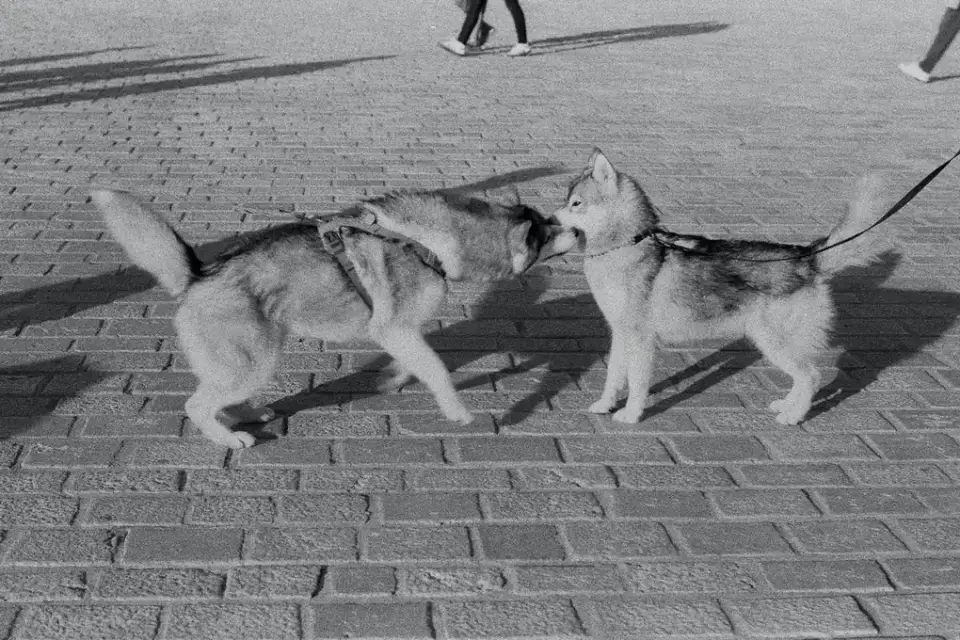
A short caution on play itself, since it’s easy to overlook: not every off-leash interaction is actually play. Watch body language before you assume two dogs are having fun together — our breakdown of play bow vs. aggression signals is worth knowing before you let your dog loose with an unfamiliar dog.
Near the end of a rehab plan, I usually have the same conversation with owners. One that stands out was a nine-year-old Labrador, about 72 pounds, who’d torn a partial CCL the year before and had done the surgery and the physical therapy well. Her owner wanted to know when she could go back to the dog park. We didn’t set a date — we set criteria: six weeks of consistent 30-minute leash walks with no lameness afterward, full weight-bearing on stairs, and a vet recheck confirming range of motion. When she hit those markers, we reintroduced off-leash time in five-minute increments in a fenced yard before letting her loose at the park. That sequencing — leash first, off-leash earned back gradually — is the same logic I’d apply to any dog rebuilding fitness after time off, not just a post-surgical one.
The bottom line
Off-leash play and leash walks aren’t competing for the same job. Off-leash time builds cardio fitness, coordination, and mental stimulation fast; leash walks build the steady, controllable mileage that conditions tissue and protects joints over time. Give a healthy dog both, weighted toward daily leash walks with off-leash sessions layered in once recall is solid and conditioning supports the higher-intensity work. Individual dogs vary — a working breed with high drive needs more off-leash outlet than a low-energy companion breed, and any dog recovering from injury or carrying extra weight should have their plan set with a veterinarian, not a general rule of thumb.
Frequently asked questions
Is off-leash play more tiring than a leash walk?
Per minute, usually yes — off-leash play involves sprinting, quick direction changes, and higher-intensity effort. But a longer leash walk can burn comparable total energy over time with far less joint and soft-tissue stress.
How often should a dog get off-leash time?
Two to three sessions a week works well for most healthy adult dogs, layered on top of daily leash walks. Puppies, seniors, and dogs recovering from injury need that ratio shifted toward more controlled leash time.
Can leash walks alone keep a dog fit?
For many dogs, yes, especially with brisk pace and enough duration. Off-leash play adds cardio intensity and mental stimulation that's harder to replicate on leash, but it isn't strictly required for fitness.
Sources
- Chondroitin sulfate and synovial fluid homeostasis review — Frontiers in Veterinary Science
- Glucosamine HCl and cartilage degradation in vitro — Journal of Veterinary Medical Science
- Green-lipped mussel powder anti-inflammatory effects — Nutrients