On this page
- The pause test is the fastest thing you can learn
- What your eyes should actually be scanning
- Size and breed mismatches make owners panic unnecessarily
- A dog park scene I still think about
- When a dog’s baseline stress is what’s driving the reactivity
- What I actually tell owners to do in the moment
- The verdict I give in the exam room
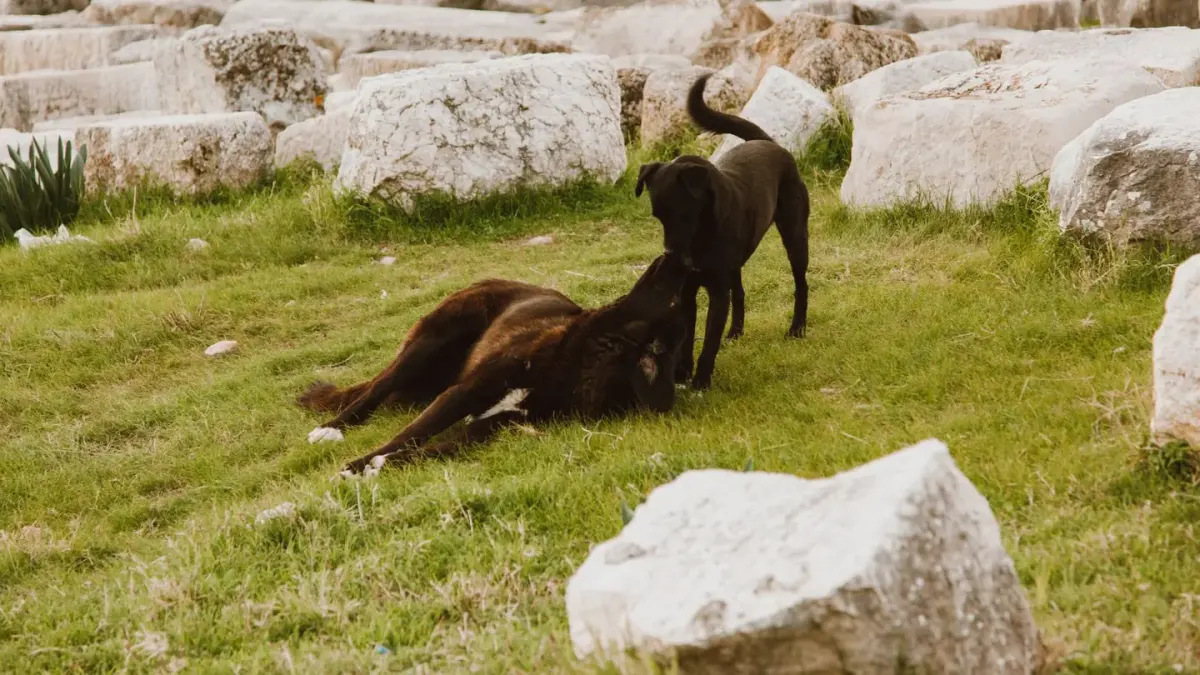
The first time I watched a Rottweiler mix pin a twelve-pound terrier to the ground and I saw the terrier’s owner go white, I understood how often play looks like violence to the untrained eye. The Rottweiler mix, an eighty-pound dog named Bruno, had the terrier’s whole head in his mouth. Nobody was bleeding. Nobody yelped. Thirty seconds later they were both panting in a heap, and the terrier climbed back on top of him for round two. That’s the moment I try to get every client to before we talk about anything else: sound and size tell you almost nothing. Rhythm tells you everything.
The pause test is the fastest thing you can learn
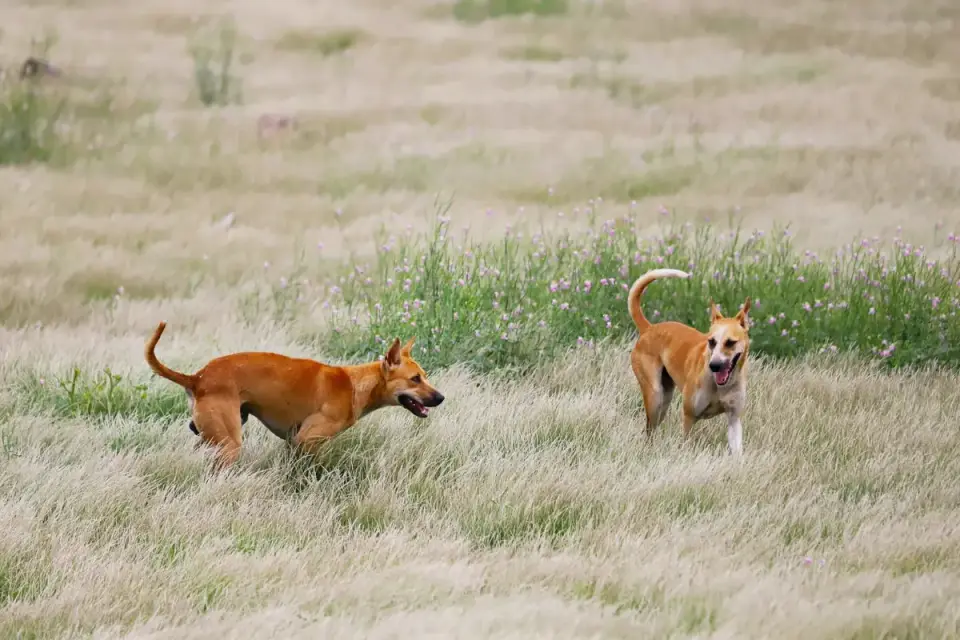
If you only take one tool home from this article, take this one. Stop the dogs, or just watch what happens when the action naturally lulls. In play, dogs self-interrupt constantly — they’ll break, shake off, sniff the ground, then dive back in within a few seconds. That reset is called a play bow, and it isn’t decorative. Front legs splayed and down, rear end up, tail loose and wagging in a wide arc: it’s a dog explicitly signaling “everything after this is still a game.” You’ll see it at the start of a session and reappear mid-tussle whenever the intensity has crept up and one dog wants to dial it back before continuing.
A fight doesn’t have that rhythm. There’s no bow, no shake-off, no voluntary reset. The body stays stiff even in the split seconds between lunges, and if you physically separate the dogs, one or both will try to re-engage immediately and with more intensity, not less. That’s the single most reliable line I give owners: play has brakes built in. A fight is trying to override them.
What your eyes should actually be scanning
Work down the dog from ears to tail, because owners tend to fixate on the mouth and miss everything else.
- Ears and eyes: relaxed, forward-and-back flicking ears and soft, blinking eyes suggest play. Ears pinned flat and a hard, unblinking stare are the two signs I take most seriously in a fight risk assessment.
- Tail: a loose, wide wag — sometimes the whole rear end swinging with it — reads as play. A tail held high and stiff, vibrating rather than swinging, is tension, not friendliness.
- Mouth: an open, relaxed mouth with visible tongue, sometimes called a “play face,” is a good sign even mid-wrestle. Lips pulled tight over the teeth, especially with the corner of the mouth drawn forward, is not.
- Body weight: play tends to be lopsided and self-handicapping — the bigger dog will flop onto its back, let the smaller one “win” a chase, or exaggerate a fall. Real aggression is efficient. There’s no self-handicapping, no offered vulnerability.
- Vocalization: this one trips people up the most. Play growls and snarls can sound alarming, but they’re usually punctuated, changing pitch, and paired with a loose body. A fight growl tends to be lower, steadier, and locked to a stiff, forward-leaning posture.
Size and breed mismatches make owners panic unnecessarily
I get calls almost weekly from owners convinced their small dog is “getting attacked” by a bigger playmate, when what I’m looking at on video is completely mutual play with a size mismatch. Bully-type and mastiff-type breeds in particular play with a lot of body contact and mouthing that reads as rough to someone used to a Cavalier’s play style. That’s a mismatch in play style, not intent. It matters more that both dogs keep returning to the interaction voluntarily than that the interaction looks gentle.
That said, mismatch can tip into a real problem fast, and this is where I ask owners to trust their gut over their eyes. If the smaller or younger dog is repeatedly trying to leave — angling its body away, tucking its tail, moving behind furniture or a person — and the other dog keeps following and re-engaging, that’s not a rough game anymore. It’s one dog no longer consenting and the other not reading it, and it needs a human to step in regardless of how “not aggressive” it looks on the surface.
A dog park scene I still think about
A few summers ago I had a case that shaped how I explain this to nearly every client now. A three-year-old Australian Shepherd named Juniper had been going to the same dog park three mornings a week for months without incident, and her owner called me convinced something had suddenly changed because Juniper had started growling and snapping at a familiar Labrador playmate during their usual chase games. Nothing about the Labrador’s behavior had changed. What had changed was that Juniper had a minor toe injury from two days earlier that her owner hadn’t clocked yet, and rough contact that used to be fun was now landing on a sore paw. Once we treated the injury, the growling disappeared within the week. I bring this up constantly because a sudden shift in a dog’s tolerance for play is data — it’s rarely “he just turned mean,” and it’s worth a vet visit before it’s treated as a behavior problem alone.
When a dog’s baseline stress is what’s driving the reactivity
Not every dog that struggles to read play cues is being aggressive in the way owners fear — some are simply carrying more background stress than their body language advertises, and that lower threshold makes ordinary rough-and-tumble play tip into a real reaction faster than it would in a calmer dog. If your dog runs generally anxious — tense at the dog park before anything even happens, slow to settle after — it’s worth addressing that baseline alongside any training. Chamomile and valerian root have a long history in traditional herbal care for supporting relaxation, and Cureus: KSM-66 Ashwagandha has moderate evidence behind it: a systematic review of multiple randomized trials concluded it has “a moderate positive impact on stress reduction and cognitive performance,” though that evidence base is largely built on human studies. L-theanine, the calming amino acid naturally found in tea, has also been studied for its calming properties, though a review published in Molecular Psychiatry found benefit mostly limited to one study on psychotic anxiety at a dose of 400 mg/day over eight weeks — a reminder that supplement research is still catching up to how these compounds are actually used in dogs. For chamomile specifically, a 2026 review in Biomedicines notes that “for the remaining species, evidence is derived mainly from preclinical studies or traditional use,” which is an honest way of saying: promising, traditional, not yet proven in controlled canine trials. None of this replaces training or a behavior consult — it’s a supporting piece, not a fix, and I say that to clients the same way every time.
What I actually tell owners to do in the moment
Here’s the practical version, stripped of theory, that I give clients standing at the dog park gate.
Watch for thirty seconds before you decide anything. If you’re unsure, call a cheerful “hey!” and see who responds — a playing dog will glance at you and often keep playing; a dog locked into conflict often won’t break focus at all. Physically separating dogs is sometimes necessary, but do it by leash or by body-blocking, never by grabbing collars near a dog’s face, since that’s where redirected bites most often land. And if you have a dog with a history of quick escalation, especially around resources like toys, food, or a favorite person, plan your play dates with dogs of a known, compatible temperament rather than leaving it to chance at an open dog park.
If your dog is new to socializing, our guide to a puppy potty-training schedule that works covers a similar age window worth reading alongside this one, and if the issue is less about other dogs and more about your dog’s excitement boiling over into nipping at you or the kids, see why does my dog get nippy and mouthy when overexcited. Dogs whose stress shows up as noise sensitivity rather than dog-to-dog conflict may benefit from the desensitization approach in my dog panics at the sound of the garbage truck.
The verdict I give in the exam room
I stand by this more than almost any other piece of advice I give: don’t judge play by volume, and don’t judge it by size mismatch. Judge it by whether both dogs keep coming back for more, whether the intensity has natural dips, and whether either dog is trying to leave and being followed. I had a client once describe her Bernese Mountain Dog’s wrestling matches with the neighbor’s Beagle as “terrifying to watch and apparently the highlight of both their weeks,” and that’s honestly the most accurate summary of play I’ve ever heard from an owner. It looks alarming because dogs communicate physically and loudly. Learn the pause, the bow, and the self-handicapping, and most of what scares owners at the dog park will stop scaring you too. When you’re still not sure, or when a normally easygoing dog’s tolerance seems to be shrinking week over week, that’s worth a call to your own vet rather than a guess — pain, illness, and rising anxiety can all masquerade as a sudden behavior problem.
Next time you’re at the park, try running the thirty-second pause test before you react. It takes less time to learn than it does to worry.
Frequently asked questions
Is growling always a sign of aggression between dogs?
No. Play growls are common and usually come with a loose, bouncy body and pauses in the action. It's the stiff posture and lack of self-interruption that signal a real problem, not the growl itself.
Should I ever intervene in play that looks rough but seems mutual?
You can still step in to give both dogs a breather, especially if one is a puppy or much smaller. Mutual, consensual roughhousing is fine, but a brief pause lets you confirm both dogs want to keep going.
Sources
- KSM-66 Ashwagandha systematic review of stress reduction — Cureus
- L-theanine and anxiety: a review — Molecular Psychiatry
- Chamomile and anxiety/stress: evidence review — Biomedicines