On this page
Dogs pull because pulling works. That’s the whole mechanism, and it’s worth sitting with before you touch a single piece of equipment.
A dog’s nose and legs are simply faster than a human gait, so from the first step out the door there’s a gap between where the dog wants to be and where the leash allows it. When the dog leans into that gap and the leash goes tight, two things happen at once: the dog gets closer to the smell, the fence line, the other dog — and the forward motion itself is reinforcing, regardless of what’s at the end of it. Opposition reflex plays a role too; when a collar or harness applies pressure, a dog’s instinct is often to lean into the pressure rather than away from it, the same way you’d brace against someone pushing your shoulder. None of that is stubbornness. It’s a dog doing exactly what four paws and a nose are built to do, on a piece of nylon that was never going to out-argue physics.
In my practice, the dog I still think about is a fourteen-month-old cattle dog mix named Otis, forty-two pounds, who came in not for a leash problem but for a shoulder limp his owner assumed was from rough play. It wasn’t. It was three months of daily walks on a flat collar, the dog hitting the end of the leash at a dead run every time a squirrel or a jogger appeared, and a slight, repetitive strain that showed up as intermittent forelimb lameness after the walk, not during it. His owner hadn’t connected the two — she’d just gotten used to bracing her own shoulder every morning. We switched him to a front-clip harness, added a structured stop-and-wait protocol, and by the six-week recheck the limp hadn’t recurred and she said the walk had “stopped feeling like a fight.” That’s a single case, not a study — but it’s the pattern I see most: the pulling gets treated as a nuisance long before anyone asks what it’s doing to the dog’s neck, trachea, or shoulders over hundreds of walks.
What’s actually driving the pull, and why punishment doesn’t fix it
The American Veterinary Society of Animal Behavior has been direct about this: reward-based methods are recommended for all dog training, including behavior problems like leash pulling, and there’s no good evidence that aversive corrections — leash pops, choke chains, prong collars — outperform reinforcement-based approaches. The reasoning tracks with the mechanism above. A correction interrupts the pull in the moment, but it doesn’t touch the reason the dog pulled in the first place, which is that forward motion and access to interesting things are reinforcing. Take the correction away and the pulling comes right back, often stronger, because the dog never learned an alternative behavior that also gets it where it wants to go.
What does work is making a loose leash the only thing that reliably produces forward progress. That’s structure/function training, not a trick: you’re changing what the leash tension predicts, from “we keep moving” to “we stop,” and letting the dog’s own behavior control the outcome.
The stop-and-wait method, and why it takes longer than people expect
The core protocol is simple to describe and genuinely tedious to run the first few sessions: the instant the leash goes tight, you stop walking — feet planted, no forward motion, no talking, no correction. You wait. When the dog turns back toward you or the leash slackens even slightly, you move forward again, and if you’re pairing it with reinforcement, that’s the moment to mark and reward at your side. The mechanics matter more than the mood: you have to do it every single time the leash tightens, or the dog learns the pulling sometimes pays off, which is a harder pattern to undo than starting from zero.
I tell owners to expect the first two or three walks to take twice as long and to plan for that instead of skipping the method when they’re in a hurry. Consistency in week one buys you a shorter walk in week four; skipping it on the days you’re rushed usually adds a week onto the whole process.
Equipment can lower the physical cost while you train
Equipment doesn’t teach a dog not to pull, but it changes how much force reaches the dog’s body while training is still in progress, and that difference is worth taking seriously. A study published in Frontiers in Veterinary Science measured leash tension across collars and harnesses and found dogs generated significantly less pulling force in front-clip harness configurations than on a flat collar. The mechanism is straightforward: a front-clip attachment redirects the dog sideways when it leans forward, which interrupts the straight-line pull rather than letting the dog’s full body weight load onto the neck. It doesn’t eliminate pulling on its own — a strongly motivated dog can still lean hard into a front-clip harness — but it removes the neck as the pressure point, which matters most for brachycephalic breeds and any dog with existing tracheal or cervical sensitivity.
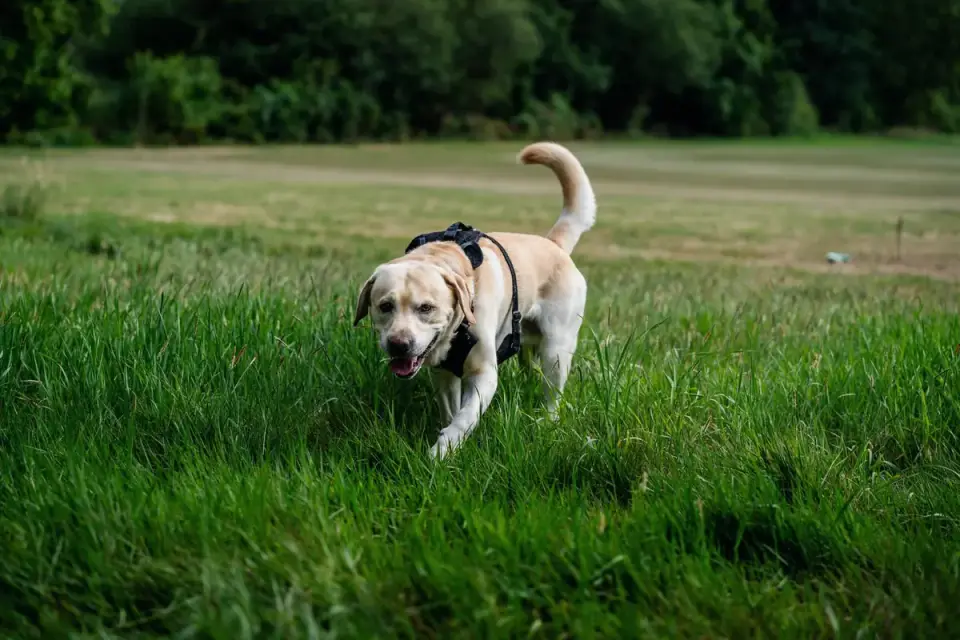
Head halters work through a different mechanism — steering the head steers the body — and can be very effective for large, strong dogs, but they require a real conditioning period before the dog tolerates one comfortably, and rushing that step is the most common reason owners abandon them.
Where structure needs to change, not just equipment
There’s a mid-walk moment I see over and over: the dog is fine for the first block, then a squirrel crosses the yard three houses down and every bit of training evaporates for four seconds. That’s not a training failure so much as a management gap — the dog hasn’t been given a job to do in that window. Building in short check-ins, asking for a sit or a hand-target every so often rather than walking in silence, keeps the dog’s attention orbiting back to you instead of scanning entirely for the next distraction. The American Kennel Club: AKC frames this the same way — engagement throughout the walk, not just correction when pulling starts, is what actually holds attention over the length of a route.
Age and stage matter here too. A four-month-old puppy still learning to walk on leash at all needs a much shorter, calmer setup than an eighteen-month-old adolescent who’s strong enough to pull an adult off balance; if you’re still working on the fundamentals, the groundwork covered in A Puppy Potty-Training Schedule That Works and How to Potty Train a Puppy touches on the same routine-building principles that make leash work easier to layer in later. And if the leash reactivity looks more like anxious over-attachment to you than pure pulling toward distractions, that’s worth reading as its own issue — see Independence Training for a Velcro Dog.
The near-verdict scene I keep coming back to involves a twenty-six-pound beagle named Daisy, seven years old, whose owner described her as “fine at home, a different dog outside.” Daisy had pulled hard toward every scent on the sidewalk for years, and her owner had simply adjusted — shorter walks, a stiff arm, a dread of the leash coming off the hook. We didn’t change her personality; we changed what the leash tension predicted and added scheduled sniff breaks so the scent-seeking had a legal outlet instead of being the thing she was fighting the leash over constantly. Eight weeks in, her owner reported the walk had gone from a chore to something she looked forward to. What changed wasn’t Daisy’s nose. It was the rules around it.
What I actually recommend
If a dog is pulling hard enough to affect the owner’s shoulder or the dog’s neck, I recommend a front-clip harness as a bridge tool while training runs in parallel — not as a permanent substitute for teaching loose-leash behavior, but as a way to lower the physical cost of the learning curve. Pair it with the stop-and-wait method, run consistently, and layer in scheduled engagement so the dog has something to do besides scan for the next distraction. Skip the leash-pop shortcuts; the evidence doesn’t support them being more effective, and the mechanism argues against them working long-term at all. If you want a faster start than trial and error at home, a private session or two can save weeks — for the tradeoffs between formats, see Group Classes vs. Private vs. Online Dog Training. Every dog on this protocol moves at a different pace, and a dog with a prior neck or spine issue should be cleared by a veterinarian before any pulling-heavy equipment is introduced.
Loose leash walking isn’t about a stronger arm or a stricter tone. It’s about making the loose leash the only door that opens.
Frequently asked questions
How long does it take to stop a dog from pulling on the leash?
Most dogs show meaningful improvement within two to six weeks of consistent stop-and-wait training, though timelines vary with the dog's age, motivation level, and how consistently every walk applies the method.
Is a harness or collar better for a dog that pulls?
A front-clip harness generally produces less pulling force than a flat collar, per measurements in Frontiers in Veterinary Science, and keeps pressure off the neck while training is still in progress.
Do prong or choke collars stop pulling faster?
They can suppress pulling in the moment, but the American Veterinary Society of Animal Behavior notes there's no good evidence they outperform reward-based training, and they don't teach the dog an alternative behavior.
Sources
- What are Reward-Based Training Methods for Dogs (and Cats)? — American Veterinary Society of Animal Behavior
- Comparison of Leash Tension Across Collar and Harness Types — Frontiers in Veterinary Science
- How to Stop Your Dog From Pulling on the Leash — American Kennel Club