On this page
Measure around the middle of your dog’s neck with a soft tape and leave room for two flat fingers underneath, then confirm the fit with the actual collar on because fur, posture, and buckle placement change the number.
So why do so many collars that match the package chart still fit badly?
The tape gives you a circumference, but the collar has to live on a moving neck with skin, muscle, trachea, and coat in between. Pressure over the front of the neck can irritate the trachea and skin with pulling, while a loose collar can slip over the ears or catch a jaw or fence. That’s why day-to-day practice favors supports-structure thinking: support comfortable restraint and ID wear, and recheck fit rather than trusting a single number.
Why the number on the tape isn’t the size to order
The neck isn’t a pipe
A dog’s neck changes shape when the nose drops to sniff, the head turns, or the leash tightens. Loose skin, a thick ruff, and seasonal shedding all lift the tape a little. The American Kennel Club notes that routine measuring helps with clothing and gear fit, and the same principle holds here: measure the dog in front of you, in a standing position, not the chart ideal.
What the two-finger gap is really for
You don’t need a crush-proof seal. You need room for normal swallowing, panting, and head movement without friction.
Slide two flat fingers under the collar at the side of the neck after buckling. They should slide without forcing and without a large gap. One finger is often too snug for medium and large dogs, and a whole hand is loose enough to invite slipping.
How to take a neck measurement that holds up
Get set up for a calm 60 seconds
Have small treats ready, a soft cloth tape, and the collar and ID tags you plan to use. Stand your dog squarely with the head level, not craned up for a treat. If you don’t have cloth tape, use a string or phone-charging cord, mark it, then lay it flat against a ruler.
In practice, Fear Free handling helps more than a second person holding tight. Reward stillness, keep sessions short, and stop if paw-lifting, lip-licking, or freezing shows stress.
Take it in the right spot
Find the middle of the neck where a flat collar will naturally sit, about halfway between ears and shoulders. Wrap the tape snug but not tight, with fur smoothed but not compressed to the skin. Keep one finger under the tape as you read it.
Record that number in inches, then add about 1 to 2 inches for small dogs and 2 to 3 inches for many medium and large dogs to reach a workable collar length. Coat makes the difference.
Check it with the real collar on
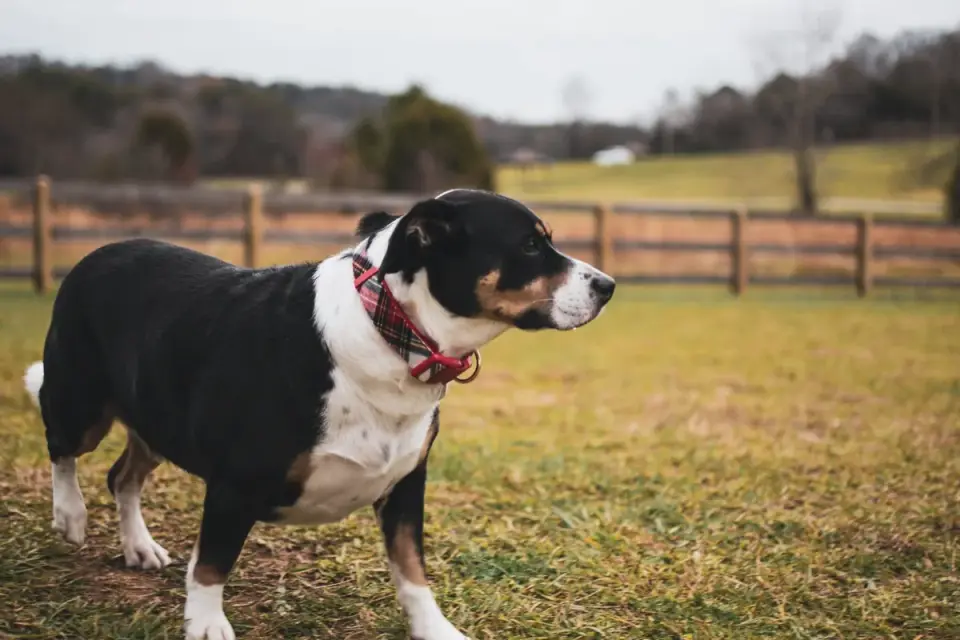
Buckle the collar, settle it in that same mid-neck spot, and do the two-finger check again. Walk a few steps on leash. The collar shouldn’t ride up behind the ears or spin freely.
Shane’s 2-year-old neutered male Saint Bernard, Kyo, shows why this last step matters. Shane’s tape read just over 24 inches through winter coat, but with the buckled collar on and Kyo standing for 2 minutes, two fingers barely fit. Smoothing less fur and moving up one buckle hole gave comfortable space without slipping over his head.
What to do with that number when you shop
Match length, width, and hardware together
Collar length is only one part of fit. Narrow 3/8-inch collars suit many toy breeds, 3/4- to 1-inch widths suit most medium dogs, and 1- to 1.5-inch widths spread pressure better on strong pullers and giant breeds. VCA Hospitals reminds owners that collars, harnesses, and leashes work as a system, so match the tool to the walk: a flat buckle collar for ID, plus a well-fit harness for a dog that pulls hard.
If you’re weighing materials after measuring, this breakdown of rolled leather versus flat nylon explains how surface friction affects coat and skin.
A martingale or slip lead follows different sizing rules and doesn’t use the same two-finger standard. Don’t apply this flat-collar method to those tools.
My take, and what would change it
I recommend owners buy for the rechecked on-dog fit, not the tape alone, and recheck monthly for puppies and seasonally for coated adults. That position comes from seeing collars that measured right yet fit wrong once fur, weight, and buckle holes entered the picture.
What would change my mind? A controlled study showing tape-only sizing predicts comfortable on-dog fit across coat types better than tape-plus-collar confirmation. Current guidance doesn’t show that, so confirmation stays.
When to remeasure instead of guessing
Growth, weight, and coat shifts
Puppies can outgrow a fit in weeks. Weight gain or loss, a spring shed, a summer clip, or a new thick winter coat can each move the fit by a hole. Vets often see rubbing or odor under collars that haven’t been reassessed, especially in wrinkled or long-haired dogs.
Recheck if you see hair loss under the band, redness, frequent scratching at the collar, slipping over one ear, or the need to force fingers underneath. For daily wear decisions, many families also find this guide to leaving the collar on overnight useful for crate and bedtime safety.
What’s the smallest habit that would keep your dog’s collar fitting right through the next coat change?
Sources
- Expert Advice — American Kennel Club
- Know Your Pet — VCA Hospitals