On this page
A client came in last spring with a nine-year-old Golden Retriever named Otis, freshly shaved down to the skin by a well-meaning owner trying to beat the heat. His coat had come in patchy and dull two months later, with bald streaks along his hips that hadn’t filled back in. The owner had used clippers because a neighbor’s Poodle got shaved every summer and looked fine. Otis is not a Poodle. That mismatch — one tool applied to the wrong coat — is the single most common grooming mistake I see walk through the door, and it’s almost always avoidable with about five minutes of coat assessment before anyone picks up a blade.
The quick answer, before the reasoning
- Double-coated dogs (Golden Retrievers, Huskies, German Shepherds, most herding and sporting breeds): scissors and a slicker brush for trims, clippers only for sanitary areas and pad hair — never a full-body shave-down.
- Single-coated, continuously growing hair (Poodles, Bichons, Maltese, Shih Tzus, Yorkies, most Doodles): clippers are standard for body work, with scissors for the face, ears, and finishing detail.
- Wire-coated terriers (Wire Fox Terrier, Border Terrier, Parson Russell Terrier): neither tool alone — these coats are traditionally hand-stripped, and clipping repeatedly softens and dulls the harsh texture breed standards call for.
- Any coat, any breed: blunt-tipped scissors for the face, feet, and ears; a small trimmer for sanitary and paw-pad hair.
- Mats: a mat splitter or comb-out first; scissors only as a last resort, and never pulled tight against skin.
- When in doubt: book one professional groom, watch how the groomer reads the coat, and copy their tool choices at home.
That’s the shape of the decision. The reasoning behind each line is where owners usually go wrong, so it’s worth walking through.
What clippers are actually built to do
Clippers shear hair at a fixed length using an oscillating blade guarded by a comb attachment. They’re efficient for covering large surface area fast, which is exactly why they’re the default tool for continuously-growing single coats like a Poodle’s or a Bichon’s — coats that don’t shed out seasonally and need regular length maintenance the way human hair does. According to the AKC, a home grooming kit should include an electric clipper or trimmer for body work, blunt-tipped scissors for stray hairs, and a mat splitter or sharp scissors for working through mats in longer coats — clippers and scissors are meant to work together, not compete.
The problem is that clippers don’t distinguish between a topcoat and an undercoat. On a double-coated dog, a clipper blade set short enough to look tidy is also cutting into the insulating undercoat, and that’s where the damage starts.
The double-coat mistake, and why it’s hard to undo
I’ve watched this play out more times than I can count, and it follows a predictable arc. An owner shaves a double-coated dog — a Husky, a Golden, a Shepherd mix — expecting relief from summer heat. The dog looks cooler for about two weeks. Then the coat starts coming back wrong: patchy, cottony, sometimes not at all in certain spots. What happened is that the guard hairs and undercoat grow on different cycles, and forcing them to restart at the same time from a shave disrupts that timing for a long while afterward. According to Artful Dog Grooming, clipping can disrupt the natural hair growth cycle so severely that a topcoat can take up to two years to fully grow back, and dogs shaved down close to the skin are at higher risk of razor burn, hot spots, and a slow-regrowth condition called post-clipping alopecia. Cutting into the undercoat is just as damaging whether you’re using clippers or scissors — the tool matters less than the depth of the cut.
That’s the reason double-coated dogs generally do better with scissors: a groomer or owner using scissors is forced to work with the coat’s natural line rather than shearing straight through it, which makes it much harder to accidentally strip the undercoat down past where it should stop.
Where scissors do the real precision work
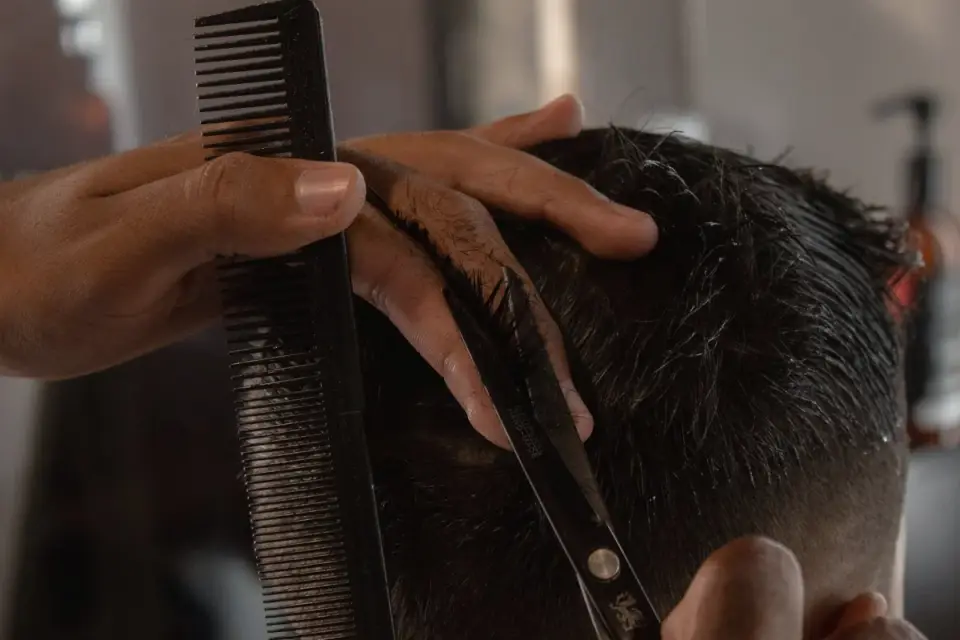
Scissors are the tool for anything that needs judgment rather than speed — the face, the feet, the ears, the tail, and any blending between a clipped body and a longer skirt. Thinning shears, a specialized scissor with one notched blade, are built specifically to soften a hard clipper line so it doesn’t look like a shelf where the guard comb stopped. Their teeth only grab a portion of the hair per cut, which is what gives a “blended” finish instead of a stair-step one. Per PetEdge, thinning shears are unforgiving near skin — because the notched teeth grip and grind rather than slice cleanly, a slip is more likely to cause real injury than a slip with standard shears, which is worth knowing before you hand a nervous dog thinning shears near a joint or a skin fold.
For most owners doing occasional touch-ups between professional visits, a pair of blunt-tipped scissors covers 90 percent of what’s needed: stray hairs around the eyes, overgrown paw fur that’s collecting debris, and the occasional sanitary trim. You don’t need thinning shears in a home kit unless you’re trying to replicate a groomer-level blend, and if that’s the goal, it’s worth practicing on a cooperative dog before attempting it on one who won’t hold still.
A short one, because it matters
Neither tool fixes a mat. Cutting a scissor blade into a mat pulled tight against the skin is one of the more common ways owners accidentally nick their dog, because the mat hides exactly where the skin surface is underneath it.
Building a kit that matches the dog in front of you, not the internet
The mismatch I see most in practice isn’t a bad tool — it’s the right tool used on the wrong coat, because someone extrapolated from a friend’s dog or a video that didn’t specify breed or coat type. Before buying anything, run your fingers down to the skin in a few spots: if you feel a soft, dense undercoat under a coarser topcoat, you’re dealing with a double coat, and clippers should stay limited to sanitary areas and pad hair. If the coat feels uniform texture all the way down and keeps growing rather than shedding out in clumps, you’re looking at a single coat suited to regular clipper maintenance.
Nail care and coat care tend to slide on the same schedule in most households, so if you’re building out a full home grooming routine, it’s worth pairing this with a look at how often you should trim a dog’s nails and how often to bathe based on coat and skin type, since bathing frequency changes how mats form in the first place. If mats are already a recurring problem despite regular brushing, that’s usually a sign the brushing routine — not the clippers — needs to change.
Where I land
Meghan, a groomer I consult with regularly, sums up the case for buying scissors before clippers this way: a scissor mistake is a bad haircut, and a clipper mistake on the wrong coat can take two years to grow out. I don’t think every owner needs a full clipper set. I think every owner needs a decent pair of blunt-tipped scissors, a slicker brush, and an honest read of their dog’s coat type before anything else gets added to the cart. The counterargument — that clippers are faster and more consistent — is true, and for single-coated breeds that need regular length maintenance, it’s the right tool for the job. But speed isn’t the priority for a double-coated dog. What’s the actual likely outcome one, two, or five haircuts from now, not just today’s convenience.
If a groom ever leaves your dog’s skin pink, flaky, or unusually itchy in the days after, or if a coat isn’t growing back evenly after a clip, that’s worth a call to your veterinarian rather than a wait-and-see approach — skin reactions and growth-cycle disruptions don’t always resolve on their own, and an early look is easier than a late one.
Frequently asked questions
Can I shave my double-coated dog to keep them cool in summer?
Most veterinarians and groomers advise against it. A double coat insulates against heat as much as cold, and shaving can disrupt the coat's growth cycle for a long time afterward rather than actually keeping the dog cooler.
Do I need thinning shears for basic home grooming?
Probably not. Thinning shears are for blending clipper lines into a natural finish, which is more of a styling step than a maintenance one. Blunt-tipped scissors handle most home touch-ups.
What's the safest tool to use around my dog's face?
Blunt-tipped scissors, moving slowly and with the dog's head held steady. Clippers are harder to control precisely in that area, especially near the eyes and ears.
Sources
- The All-Purpose Grooming Tool Kit — AKC
- Double-Coated Dogs: Risks of Clipping — Artful Dog Grooming
- The Ultimate Dog Grooming Shears Guide — PetEdge