
On this page
- Cheese Isn’t a Free Pass Just Because It Isn’t on the Toxic List
- Puppyhood: Cheese as a High-Value Training Tool
- The Adult Dog’s Daily Ledger: Fat, Salt, and the Ten Percent Rule
- When the Gut or Pancreas Is Already Working Hard
- Senior Dogs and the Cumulative Cost of Small Indulgences
- Reading the Cheese Aisle Like a Clinician
- Where This Leaves Your Dog’s Diet
Cheese isn’t a toxin on any list, but that’s a low bar, and it’s the wrong question to be asking your dog’s bowl.
Before anything else, here’s the checklist I actually use when an owner asks me about cheese as a treat:
- Fat content first — mozzarella and cottage cheese sit far below cheddar, cream cheese, or aged varieties.
- History matters more than breed — a dog with prior pancreatitis or GI disease should treat cheese as the exception, not the default.
- Portion stays small — a pea-sized piece for a small dog, a cube for a large one, not a slice.
- Flavoring is a hard stop — anything cut with onion, garlic, or chive powder is off the table entirely.
- Daily habit versus occasional reward — the math changes completely depending on which one you’re doing.
Each of those deserves more than a bullet point, so let’s work through them in the order they actually matter for a dog’s health.
Cheese Isn’t a Free Pass Just Because It Isn’t on the Toxic List
A lot of owners treat the absence of a warning label as a green light, as if anything that isn’t garlic or grapes must be nutritionally neutral. It isn’t. Cheese is concentrated fat, protein, and sodium in a form dogs find nearly impossible to resist, which is exactly why it works so well as a training reward and exactly why it can quietly undermine a diet plan. The American Kennel Club notes that cheese carries very high fat, calorie, and salt content relative to its size, and that owners should watch for digestive upset and favor lower-fat options. That framing, not a simple yes-or-no, is the one worth carrying into your kitchen.
Puppyhood: Cheese as a High-Value Training Tool
Imagine a twelve-week-old puppy learning to sit at the edge of a busy sidewalk, distracted by every passing scooter and stranger’s shoe. A trainer breaks off pea-sized pieces of low-fat mozzarella between reps, because the puppy will work for it in a way kibble alone doesn’t reliably earn. That’s a legitimate use of cheese, and I don’t discourage it. What I ask owners to track instead is the running total across a training session, because a dozen tiny rewards can add up to real calories in a dog under twenty pounds. The same instinct that has me weighing an imaging study against a course of acupuncture in a neurology consult applies here: match the tool to the job, and stop once the job is done.

The Adult Dog’s Daily Ledger: Fat, Salt, and the Ten Percent Rule
Most veterinary nutrition guidance treats treats, cheese included, as capped around ten percent of a dog’s daily calories, with the rest coming from a complete and balanced diet. That’s a useful ceiling, not a target to aim for. A working retriever burning through a long hike can absorb an occasional cube of cheddar without much consequence. A sedentary senior dog with a few extra pounds already on board cannot, and the difference has nothing to do with breed and everything to do with that individual dog’s activity, weight, and GI history.
When the Gut or Pancreas Is Already Working Hard
This is where cheese stops being a simple treat-aisle question and becomes a whole-patient one. Dogs with exocrine pancreatic insufficiency, a condition in which the pancreas no longer secretes enough digestive enzymes, are already managed on low-residue, moderate-fat diets alongside enzyme replacement and cobalamin support, according to a review in the Journal of the American Veterinary Medical Association (JAVMA). Layering a high-fat cheese onto that kind of gut is asking for trouble it doesn’t need. Dogs recovering from pancreatitis face a similar calculation, since fat is the direct trigger for that inflammation, not lactose.
Even for dogs without a diagnosed condition, gut response to dietary changes is individual and harder to predict than owners often assume. A pilot study in Frontiers in Veterinary Science, titled ‘Pilot Study Evaluating Tolerability and Changes in Fecal Microbiota Associated With Novel Probiotic Administration to Dogs With Diarrhea’, found that diversity metrics in fecal microbiota did not reliably distinguish dogs who responded well to a probiotic intervention from those who didn’t, underscoring how much individual variation sits beneath the surface of a dog’s digestive tolerance. Cheese is a small dietary input, but it’s still an input into a system that doesn’t behave identically across dogs.
Senior Dogs and the Cumulative Cost of Small Indulgences
Consider an eleven-year-old dog whose owner has kept the same nightly ritual for years, a corner of cheese slipped over while dinner is being prepared. Nothing about that habit ever caused an obvious problem, which is part of the issue. Senior dogs carry more silent GI sensitivity and slower metabolisms than most owners give them credit for, and a habit that was harmless at four can sit differently at eleven. If a senior dog’s diet is already being adjusted for age or a health condition, that’s the moment to reassess small daily extras like cheese rather than assume they’re grandfathered in. Our guide on switching a senior dog to a new food walks through how to make those changes without disrupting a dog that’s already sensitive to shifts in its routine.
Reading the Cheese Aisle Like a Clinician
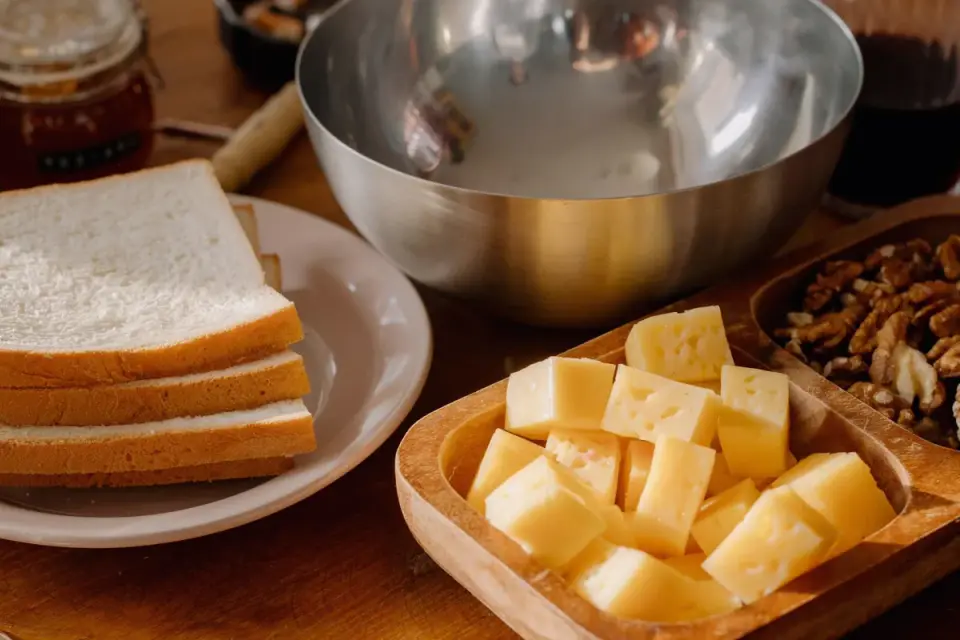
Not every cheese carries the same risk profile. Part-skim mozzarella, plain cottage cheese, and small amounts of soft goat cheese run lower in fat and sodium than cheddar, cream cheese, or aged hard cheeses, which makes them the more forgiving choice for a dog prone to GI upset. Blue-veined and heavily moldy cheeses are worth avoiding outright, since certain mold byproducts used in their production carry real toxicity. And any flavored cheese deserves a label check before it reaches a dog’s mouth. Herb-and-garlic cheddar or onion-dill varieties aren’t a cheese problem at all; they’re a hidden-ingredient problem, similar to the risk covered in our piece on whether garlic is safe for dogs in small amounts. If a treat rotation needs variety beyond dairy, plain cooked sweet potato is a lower-fat option worth keeping in the same drawer; see our guide on feeding dogs sweet potato safely for portions.
Where This Leaves Your Dog’s Diet
A small piece of the right cheese, used deliberately, isn’t something I ask most healthy dogs to give up. What I do ask owners to give up is the assumption that ‘dogs can eat cheese’ settles the matter on its own. It doesn’t account for the dog in front of you, that dog’s pancreas, that dog’s weight, and that dog’s history. Treat cheese the way you’d treat any concentrated, palatable food: useful in small, deliberate amounts, and worth reconsidering the moment a dog’s GI history, weight, or medical picture changes. Bring your dog’s specific situation to your own veterinarian before making cheese a habit rather than an exception, especially if there’s any history of pancreatitis or chronic digestive disease.
Frequently asked questions
Is a little bit of cheese every day bad for a dog?
For most healthy adult dogs, a small daily piece of a low-fat cheese isn't dangerous, but it adds up in calories and fat over weeks and months. It works better as an occasional reward than a routine addition to the diet.
Can dogs with lactose intolerance eat cheese at all?
Aged, hard cheeses contain very little lactose compared to milk, so some lactose-sensitive dogs tolerate a small piece without issue. Others still react, which is why a first taste should always be small and watched.
What about blue cheese or cheese with mold in it?
Skip it. Certain molds used in blue-veined cheeses can produce compounds that are genuinely harmful to dogs, and it isn't worth the trade for what's essentially a garnish cheese.
Is string cheese or mozzarella a safer choice than cheddar?
Generally yes. Part-skim mozzarella and plain cottage cheese run lower in fat and sodium than cheddar, cream cheese, or aged varieties, which makes them gentler on a dog's pancreas and waistline.
Sources
- Exocrine Pancreatic Insufficiency in Dogs and Cats — Journal of the American Veterinary Medical Association (JAVMA)
- Pilot Study Evaluating Tolerability and Changes in Fecal Microbiota Associated With Novel Probiotic Administration to Dogs With Diarrhea — Frontiers in Veterinary Science
- Is It Safe to Give My Dog Cheese? — American Kennel Club (AKC)