
On this page
A retriever mix named Otis used to meet his owner at the back door every evening, tail going, because that was when the apple came out. She’d core it, slice it thin, and hand him a piece while she started dinner. It was a small ritual, the kind that feels harmless because it is, mostly. What she hadn’t thought through was the whole apple she left on the counter some mornings, core and all, within easy reach of a dog who could clear a countertop in one hop. Nothing happened to Otis. But the gap between a hand-fed slice and an unsupervised whole apple is exactly where most of the real questions about this fruit live, and it’s worth walking through with the same care I’d bring to reading an MRI: what’s actually there, what’s incidental, and what changes the picture for a specific dog.
What apples actually give a dog
Apples are mostly water and carbohydrate, with a meaningful dose of fiber concentrated in the skin, plus vitamin C, vitamin A, potassium, and a spread of antioxidant compounds, according to the American Kennel Club. None of that is dramatic. It’s not a superfood in the marketing sense, and it isn’t going to replace anything in a complete commercial diet. What it can do, in a thin slice or two, is add texture and moisture to a treat rotation without the fat and calorie density of a lot of baked biscuits. The AKC also notes a whole apple runs close to 19 grams of sugar, which is the number that should anchor your portion size more than anything else on the ingredient side.
I think about fiber the way I think about most interventions in this field: mechanism first, promise second. Pectin, the soluble fiber concentrated in the peel, forms a gel-like matrix in the gut that can slow transit and feed the resident bacterial population. That’s a plausible, structure-level reason apple skin may help support normal stool consistency in a dog whose gut is already working normally. It is not a treatment for diarrhea, and it is not a substitute for diagnosing why a dog has loose stool in the first place.
Where the actual risk sits
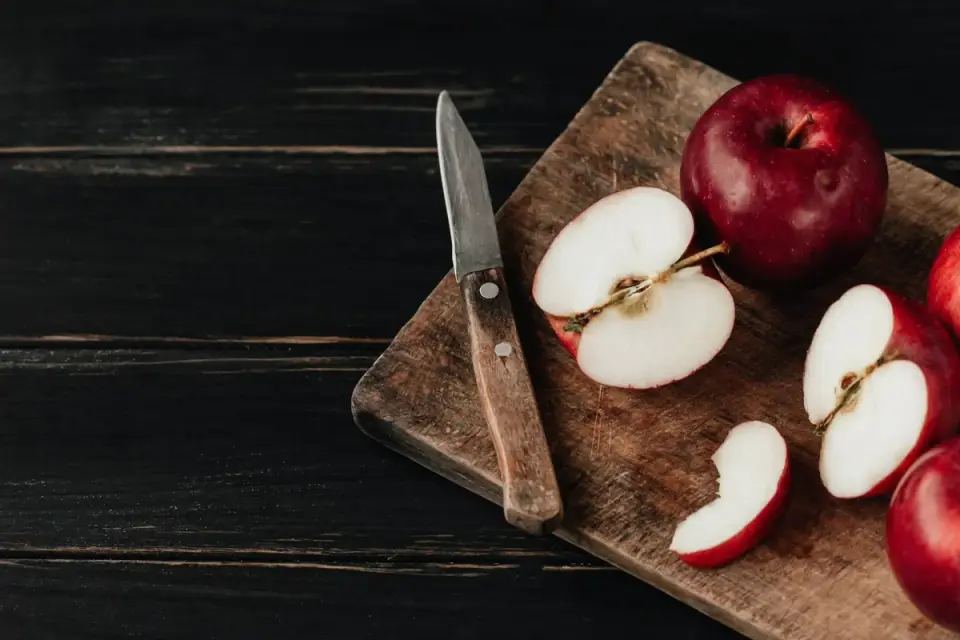
The caution that gets repeated most, and for good reason, is about the seeds. They contain amygdalin, a cyanogenic compound that can release cyanide when crushed and digested, and the ASPCA lists the stems, leaves, and seeds of the apple plant as toxic for exactly this reason. The dose that matters is large, closer to a mouthful of thoroughly chewed seeds than the handful a dog might swallow whole from a couple of slices you handed over. Intact seeds tend to pass through with minimal release. Still, I don’t see a reason to leave that math up to chance when coring an apple takes ten seconds. The core and stem carry a separate, more mundane hazard: they’re a choking and obstruction risk, particularly in small dogs or fast eaters, independent of anything chemical.
One short point worth sitting with on its own: whole apples left within reach are the actual risk, not the fruit itself.
There was a dog I think about often in this context, not a specific patient but a composite of the concern I hear from owners and see echoed across veterinary discussion boards: a middle-aged dog who’d always tolerated apples fine, then started declining them, losing weight, and passing pale, greasy stool. That constellation points toward exocrine pancreatic insufficiency, a condition where the pancreas stops producing enough digestive enzyme, and it changes the fiber conversation entirely. JAVMA notes that EPI is treated by pancreatic enzyme replacement therapy, nutritional management with low-residue diets with moderate fat content, and supplementation of cobalamin. A high-fiber snack that’s perfectly reasonable for a healthy dog can work against that kind of nutritional plan, adding bulk a compromised gut isn’t equipped to process efficiently. This is the part of the picture I want owners to carry away, more than the seed math: what a food does depends on the gut it’s entering, not just on the food.
Portion sense and who should skip it
For a healthy adult dog, a slice or two, peeled if the gut is sensitive, unpeeled if it isn’t, is a reasonable occasional treat. Puppies should get even less, introduced gradually, with a watch for loose stool over the following day. Dogs already managing pancreatitis, diabetes, or a diagnosed GI condition are the group I’d steer toward skipping apple treats altogether, or clearing the amount with their own veterinarian first, given the sugar and fiber load involved. The broader research on how individual dogs’ gut microbiomes respond to dietary and probiotic changes is still unsettled. A Frontiers in Veterinary Science study on probiotic response found that diversity metrics did not distinguish non-responders from responders, which is a useful reminder that gut reactions to any dietary addition, apples included, vary by dog in ways we can’t fully predict from a stool sample alone.
Apples share a category with a handful of other produce items owners commonly ask about, and the same logic applies across most of them: know which part of the plant carries the risk, and size the portion to the dog in front of you rather than to general advice. If you’re already thinking through produce swaps, our guide to sweet potato covers a similar low-risk, high-fiber option, and our piece on garlic walks through a case where the plant-part caution is much less forgiving than it is with apples.
Where this actually lands
I don’t think apples deserve either the alarm some seed warnings generate or the halo they get in treat marketing. They’re a modest, mostly water-and-fiber snack that’s genuinely fine for most dogs in small amounts, with a short list of real preparation steps: core it, seed it, slice it thin, and watch the total sugar over a week rather than a day. For dogs already managing a digestive or metabolic condition, the calculus shifts, and that’s worth a conversation with your own vet rather than a rule of thumb from an article. If you’re setting up feeding routines more broadly, our guide to transitioning a senior dog’s food covers how to introduce any new item, apples included, without upsetting a gut that’s already adjusting to enough.
Otis, for what it’s worth, is still getting his evening slice. The core just doesn’t make it to the counter anymore.
Frequently asked questions
Can dogs eat apple skin?
Yes. Most of the fiber and some of the antioxidant content sits in the peel, so leaving it on is fine for dogs who tolerate it. If your dog has a sensitive gut, peeling the slice can make it easier to digest.
How many apple seeds are dangerous for a dog?
A dog would have to chew and swallow a large quantity of crushed seeds, not a few incidental ones, before cyanide exposure became a real concern. That said, there is no reason to take the risk. Core the apple and move on.
Are apples better than commercial dog treats?
Not automatically. Apples are lower in calories than many baked treats, but they are still a source of sugar. Think of them as an occasional, not a daily, addition, and count them against your dog's total calorie intake.
Can puppies eat apples?
In very small amounts, yes, once they are eating solid food. Start with a thin sliver, watch for loose stool, and keep portions smaller than you would for an adult dog.
Sources
- Can Dogs Eat Apples? How to Safely Feed Apples to Dogs — American Kennel Club
- Toxic and Non-toxic Plants: Apple — ASPCA
- Exocrine pancreatic insufficiency review — JAVMA
- Probiotic response variability study — Frontiers in Veterinary Science