On this page
A dog wearing a harness labeled “reflective” is not automatically a visible dog. What matters is a narrower, more physical question: does the material on that harness actually intercept a beam of light and send it back where it came from. Most nighttime dog-vs-car near-misses trace back to that gap between what a product tag promises and what the fabric on it is built to do.
Why “Reflective” on the Tag Doesn’t Guarantee Visibility
The word reflective gets used loosely in pet gear marketing, and it covers two very different materials with very different nighttime performance. True retroreflective material is engineered with microscopic glass beads or micro-prisms embedded in the fabric, and its job is narrow: take incoming light and send it back almost directly toward its source. A car’s headlights are the source that matters on a walk, so retroreflective trim performs best when it’s roughly in the headlight beam’s path. Fluorescent, or neon, fabric works on an entirely different mechanism. It absorbs ultraviolet light from the sun and re-emits it as visible color, which is why a neon harness looks so bright at 6 p.m. Car headlights emit almost no UV light, so that same harness goes flat and ordinary the moment real darkness sets in, according to the material breakdown from Safe Reflections. A harness can be technically “reflective” by using fluorescent thread and still fail the one test that counts on a dark street.

Where the Reflective Panels Sit Matters More Than How Much There Is
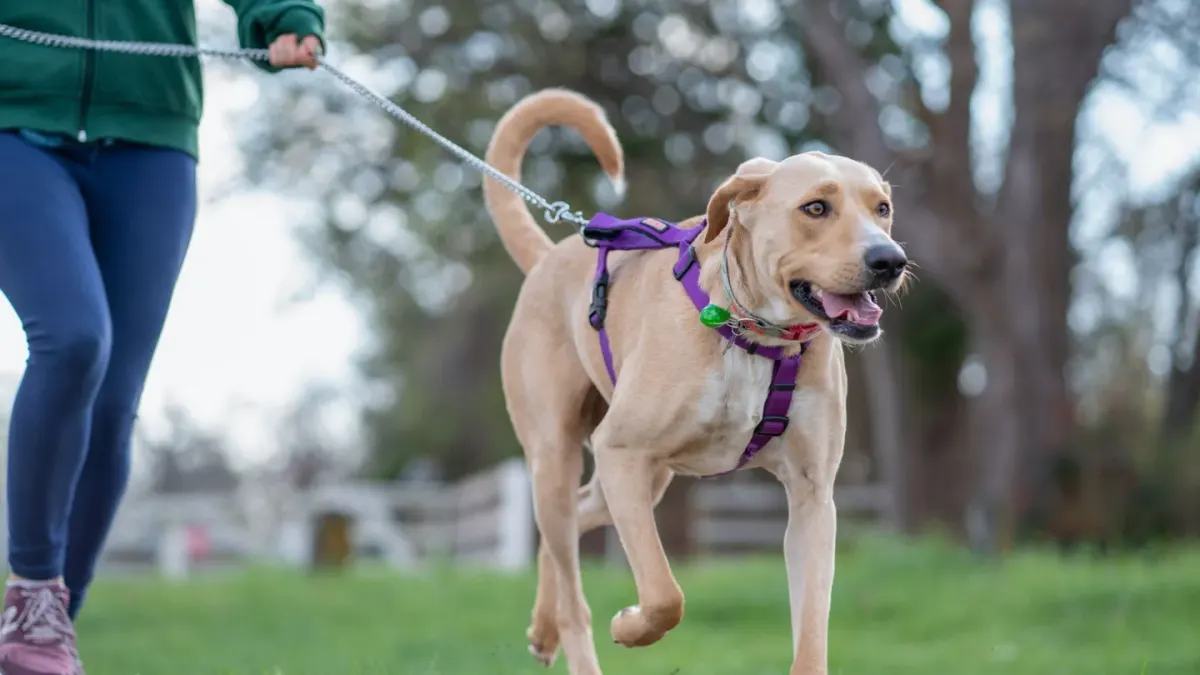
A driver scanning a dark road isn’t looking for a static glow. Human vision is tuned to notice motion, and research on pedestrian conspicuity has found that reflective markers placed on the body’s moving joints, ankles, wrists, knees, are recognized faster and from farther away than the same amount of reflective material worn as a single solid patch, because the moving points sketch out a recognizable walking shape even before a driver consciously identifies a person or animal, per the clothing and headlamp research summarized on ResearchGate. The same logic carries over to a dog. A harness with reflective piping across the chest, sides, and back, over the shoulder and rib movement of a walking dog, reads as a moving shape sooner than one strip across the spine. That’s also why a collar alone underperforms a harness. A collar sits close to the neck, gets buried under a thick or fluffy coat, and moves the least of any point on the dog’s body, so it contributes little to the motion cue a driver actually notices, a point echoed in Preventive Vet’s guidance on nighttime gear.
A single reflective strip is better than nothing. It just isn’t the same as coverage engineered around how a dog actually moves.
Reflective Trim and Lights Solve Different Problems
Retroreflective material is entirely passive. It has nothing to give back on a road with no working headlights nearby, on a dim trail, or at the moment a driver’s high beams are aimed slightly off-angle. That’s the gap a small clip-on LED or a light-up collar closes, since it generates its own light instead of depending on someone else’s beam finding it first. Whole Dog Journal’s rundown of high-visibility gear treats the two as complementary rather than interchangeable: reflective trim for when headlights are present and roughly aligned, an active light for the stretches where they aren’t. Walkers who cover unlit parks, trails, or predawn routes get more real benefit from a harness that pairs a retroreflective build with a light loop or clip point than from either feature alone.
What to Actually Check Before Buying
Fit matters as much as material. A harness that’s loose enough to twist lets the reflective panels rotate off the dog’s sides and out of a driver’s sightline, which defeats the placement advantage entirely. Look for a snug, adjustable fit that keeps the reflective strips flat against the chest and back rather than sagging or bunching. Coverage should wrap around more than the top of the spine; side and front panels catch headlights from angles a top-only strip misses entirely, particularly at intersections where a car is approaching from the side rather than straight on.
The leash and the handler are part of the same visibility problem and are easy to overlook. A glowing dog on the end of a plain dark leash, walked by someone in dark clothing, still leaves a driver reading an incomplete picture in the half-second that matters. If your walks already lean on other safety gear, layering makes sense: dog owners managing a bolt risk sometimes pair night-walk visibility gear with a GPS tracker for an escape-prone dog so a slipped leash at dusk doesn’t turn into an unfindable dog after dark. And if your routine includes walks in an unfamiliar city, the same reflective-gear logic applies whether you’re navigating a new neighborhood after landing on a trip covered in our guide on how to fly with a dog or just walking the usual block once the clocks change.
None of this requires exotic gear. It requires matching the material to the mechanism, retroreflective for headlights, active light for everything else, placed where a driver’s eye is already looking for motion, rather than trusting a single word printed on a hang tag.
Frequently asked questions
Is a reflective collar enough, or do I need a harness?
A collar sits close to the neck and is easily hidden by a thick coat or a lowered head, so it reads as a small, inconsistent glint rather than a clear shape. A harness spreads reflective material across the back, chest, and sides, giving a driver a bigger, steadier signal from more angles.
Does reflective gear work under streetlights, or only headlights?
Retroreflective material is built to bounce a beam straight back toward its source, which is why it performs best in a car's headlights. Streetlights sit off to the side, so the reflected light scatters away from the driver rather than back at them, which is one reason a small clip-on light is a useful backup on unlit streets.
Can fluorescent (neon) fabric substitute for reflective material at night?
No. Fluorescent color needs ultraviolet light from the sun to glow, and headlights emit almost none of it, so a neon harness that looks bright at dusk behaves like a plain dark fabric once full night falls.
Sources
- Light-Up Collars & Harnesses For Dogs At Night — Preventive Vet
- High Visibility Clothing and Gear For You and Your Dog — Whole Dog Journal
- Lighting the Way: Understanding Retroreflective and Fluorescent Materials for Maximum Visibility — Safe Reflections
- Pedestrian visibility at night: Effects of pedestrian clothing, driver age, and headlamp beam setting — ResearchGate