
On this page
A Labrador named Gus taught me most of what I know about free-feeding. He was four years old, sixty-one pounds, and his owner kept his bowl topped off around the clock because he’d “graze like a cat.” Except Gus didn’t graze — he inhaled. By the time I saw him, he’d put on nine pounds in a year, and his stool had gone from firm to loose and unpredictable, no obvious trigger, no diet change. We switched him to two measured meals a day. Within three weeks his stool had normalized, and within four months he was back to a healthy weight. I’ve watched this exact pattern play out often enough that I no longer consider it a coincidence.
Why the question even matters
Free-feeding — leaving a full bowl out so a dog can eat whenever it wants — sounds humane. No begging, no clock-watching, no drama at 5 p.m. But dogs are not naturally self-regulating eaters the way some cats are. Most dogs will eat what’s in front of them, whether or not they’re hungry. Scheduled feeding, by contrast, means two or three defined meals a day, measured and offered at consistent times.
The debate isn’t really about convenience. It’s about what a dog’s gut and metabolism do with a steady trickle of food versus discrete meals.
What changes inside the dog
A dog’s digestive tract isn’t built to process a slow, continuous stream of kibble the way a grazing animal’s might be. Meals trigger a coordinated cascade — gastric acid, enzyme release, motility — that works best when it has a defined start and stop. Feed constantly, and you blunt those signals; feed on a schedule, and you give the gut a rhythm to work with.
This matters most for dogs whose pancreas is already under strain. In cases of exocrine pancreatic insufficiency, a condition where the pancreas can’t produce enough digestive enzymes, management includes not just enzyme replacement but also structured nutritional support — a review in JAVMA notes that EPI is treated by pancreatic enzyme replacement therapy, nutritional management with low-residue, moderate-fat diets, and supplementation of cobalamin. That’s a clinical extreme, not what most healthy dogs face, but it illustrates a broader point: how and when a dog eats interacts with how well it digests.
Even dogs without a diagnosed GI disorder show individual variation in how their gut microbiome responds to dietary intervention. Research published in Frontiers in Veterinary Science on probiotic supplementation in dogs found that diversity metrics did not distinguish non-responders from responders — a reminder that gut health isn’t a single dial you can turn with one change, feeding schedule included. Meal timing is one lever among several, not a cure-all.
The weight problem nobody argues about
Where the evidence is least ambiguous is body condition. A bowl that’s always full removes the natural cue a dog would otherwise get from hunger and satiety. Multi-dog households make this worse — one dog’s portion becomes fair game for another, and nobody’s tracking who ate what. Scheduled feeding puts a person back in charge of the portion, which is really the only lever an owner has over a dog’s calorie intake day to day.
I don’t think free-feeding is reckless in every home. A lean, active, single dog with no history of GI sensitivity or resource guarding can sometimes tolerate it without incident. But that’s a narrower set of dogs than most owners assume they’re describing when they choose free-feeding for convenience.
Where scheduled feeding earns its keep
Scheduled meals give you something free-feeding can’t: a baseline. If a dog skips a meal, you know within hours, not days. If stool consistency shifts, you can tie it to a specific feeding rather than guessing across a day of grazing. That diagnostic clarity is worth more than most owners realize until they’re on the phone with a vet trying to describe “how much” their dog has eaten over an unmonitored 24 hours.
There’s also a digestive-support angle worth naming plainly, not as a cure but as a structure/function consideration: fiber quality matters regardless of feeding pattern. Pumpkin fiber, for instance, is a gentle, natural source of both soluble and insoluble fiber, and it’s often used to help firm up stool in dogs whose GI transit runs fast or loose — something that’s easier to evaluate against a known meal schedule than against constant grazing.
None of this means scheduled feeding is flawless. Dogs prone to anxiety or resource guarding can become more food-focused around mealtimes, and puppies, small-breed dogs prone to low blood sugar, and some senior dogs with reduced appetite may genuinely need more frequent, smaller meals rather than fewer large ones.
A scene from the exam room
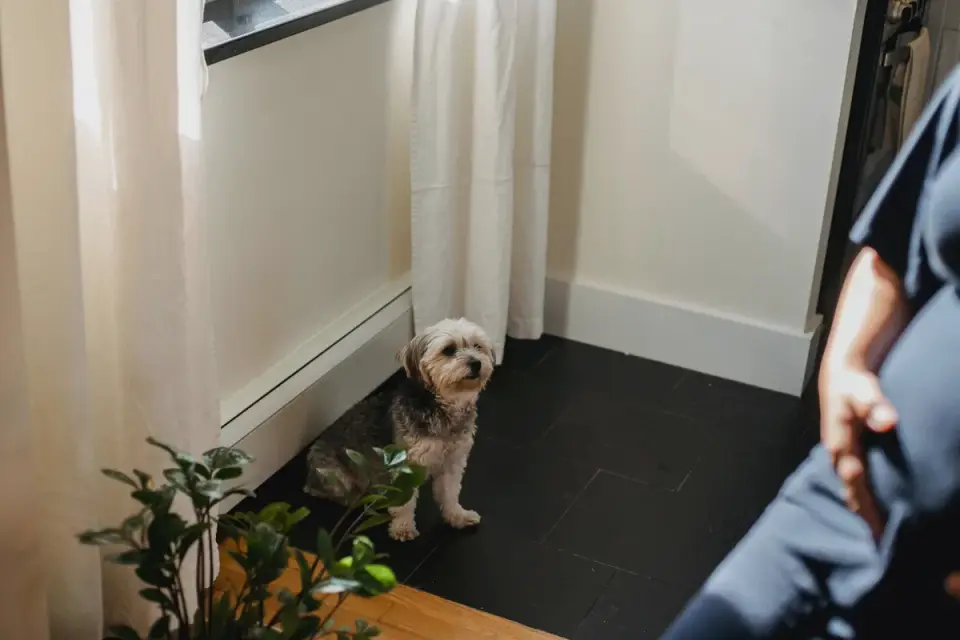
I think about a Dachshund I worked with, seven years old, fourteen pounds, whose owner insisted his weight gain “came from nowhere.” It hadn’t. The dog had free access to food in a household with two teenagers who each topped off the bowl separately, assuming the other hadn’t fed him yet. Nobody was lying — nobody even knew there was a problem. We moved him to two scheduled meals, measured by the owner alone, no exceptions. His weight came down over about five months, and just as tellingly, the owner started noticing things she hadn’t before: he was slower to finish his evening meal on hot days, faster after a walk. That kind of pattern-reading is only possible when meals happen on a schedule you can compare against.
If your dog is a picky eater, scheduled feeding can also be a diagnostic tool rather than a fight. A dog who skips a scheduled meal is telling you something; a dog grazing from a full bowl all day can mask the same signal for weeks. For treat-based training or snacks between meals, foods like apples or bananas in modest amounts fit more naturally into a scheduled routine, where you can account for the extra calories against a known baseline — versus free-feeding, where treats just stack on top of an already-unmeasured intake. And if you’re rethinking what belongs in the bowl at all, it’s worth knowing which foods to keep out entirely, onions among them.
What I’d actually tell you to do
For the overwhelming majority of healthy adult dogs, I recommend scheduled meals — two a day for most adults, more frequent for puppies or dogs with a medical reason to eat smaller amounts more often. The strongest case against this is real: some owners genuinely can’t stick to a schedule because of erratic work hours, and an inconsistent schedule can be worse than a consistent free-feed setup. If that’s your household, a timed automatic feeder that dispenses set portions at set times gets you most of the benefit of scheduling without requiring you to be home at noon.
Individual dogs vary — a dog with a documented history of tolerating free access well, verified by stable weight and normal stool over time, doesn’t need to be forced into a new routine just because it’s the general recommendation. But if you’re not sure how much your dog eats in a day, that uncertainty is itself the argument for a schedule.
So which are you actually optimizing for when you fill that bowl — your dog’s convenience, or your own?
Frequently asked questions
Is free-feeding ever okay for dogs?
It can work for some lean, active adult dogs with no history of GI sensitivity or resource guarding, but it removes your ability to track appetite changes and makes overeating easy to miss, especially in multi-dog homes.
How many meals a day should a healthy adult dog get?
Most healthy adult dogs do well on two measured meals a day; puppies and some small-breed or senior dogs may need more frequent, smaller meals.
Can switching from free-feeding to scheduled meals help with loose stool?
It can help you identify patterns, since a consistent schedule makes it easier to connect a stool change to a specific meal rather than a day of unmonitored grazing — though persistent GI symptoms should be evaluated by a vet.
Sources
- Exocrine Pancreatic Insufficiency Review — JAVMA
- Probiotic Response and Gut Microbiome Diversity in Dogs — Frontiers in Veterinary Science