
On this page
- Why Access Speed Matters More Than the Pouch Itself
- Hip-Mounted vs. Cross-Body: Two Honest Options
- Loading the Pouch: Size, Value, and Rotation
- The Physiology Behind the One- to Two-Second Window
- Marker Word vs. Clicker: Both Pair With a Pouch
- Common Mistakes That Blunt a Pouch’s Value
- Fading the Pouch Without Losing the Behavior
To use a training treat pouch well, wear it snug, load pea-sized rewards, and deliver them within two seconds. That single window — not the pouch’s color, capacity, or brand — is what separates a training session that sticks from one that stalls out.
Why Access Speed Matters More Than the Pouch Itself
A treat pouch exists to solve one problem: getting a reward into a dog’s mouth fast enough for the dog to connect it to the behavior that earned it. AVSAB describes treats as reward-based reinforcers that work by following a desired behavior closely enough for the dog to form a clear association between the two. Fumbling with a zipper, a pocket, or a treat bag with a stiff clasp adds seconds you don’t have.
Think of the pouch as a delivery mechanism, not a snack drawer. Magnetic or spring-hinge closures that pop open with one hand outperform pouches you have to dig into. If you find yourself looking down to open it, the design is working against you.
Hip-Mounted vs. Cross-Body: Two Honest Options
Hip pouches clip to a belt or waistband and sit at your dominant hand’s side. They’re the fastest option for straightforward heel, sit, and recall work because your hand travels the shortest distance from pouch to dog.
Cross-body pouches hang from a strap across the chest or shoulder. They stay put during footwork-heavy training — agility foundations, loose-leash turns, or any drill where you pivot, kneel, or change direction often. The tradeoff is a slightly longer reach to the opening.
Neither design is objectively better. Match it to what your body actually does during a session, not to what looks tidiest on a shelf.
Loading the Pouch: Size, Value, and Rotation
Cut treats down before the session starts, not mid-session. The AKC notes that pea-sized pieces — even for large breeds — keep a dog eating and refocusing quickly rather than settling in to chew.
Load more than you think you’ll need. Running out mid-session forces you to break rhythm exactly when a dog is building momentum on a new behavior.
Rotate value. Save higher-value items — freeze-dried meat, cheese — for new or difficult skills, and use lower-value kibble-style pieces for behaviors your dog already knows well.
The Physiology Behind the One- to Two-Second Window
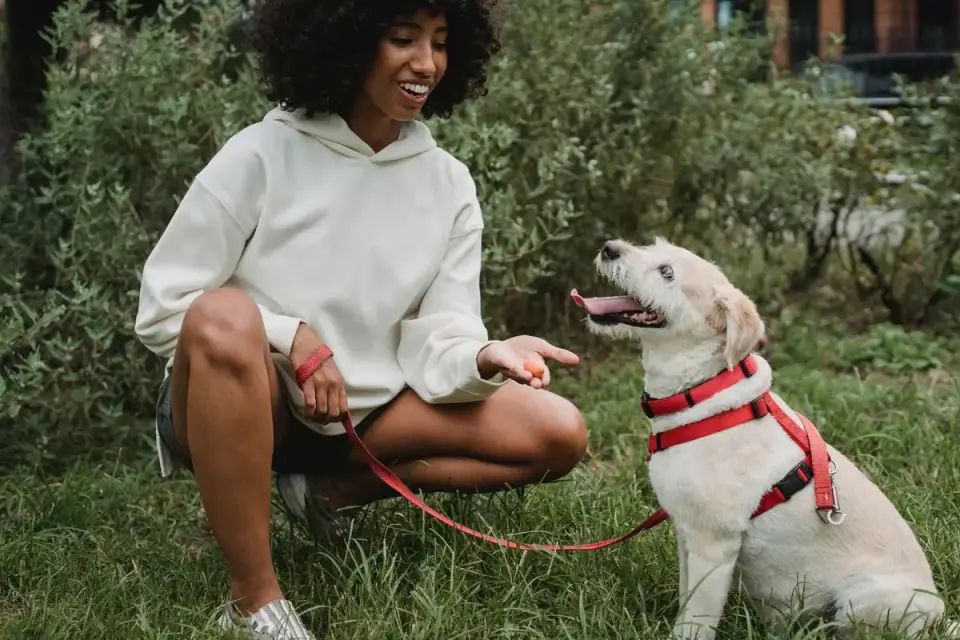
Dogs don’t reason backward through a sequence of events the way people do. They form associations most strongly between a behavior and whatever follows it within a short, tight window. Delay the reward and the dog is more likely to link the treat to whatever it happened to be doing at that later moment — sniffing, shifting its weight, looking away — rather than the behavior you meant to reinforce.
This is the entire argument for wearing the pouch at all. A treat sitting in a distant bag or a coat pocket simply can’t beat the clock.
Marker Word vs. Clicker: Both Pair With a Pouch
A pouch doesn’t replace a marker; it backs one up. Some handlers use a clicker, others a short verbal marker like “yes.” Either works as long as it’s followed, within roughly a second or two, by a treat coming out of the pouch.
The clicker’s advantage is consistency — it sounds the same every time, with no variation in tone. The marker word’s advantage is that your hands stay free and you don’t need to carry an extra tool. Choose based on what you’ll actually use reliably across every session, not which one seems more advanced.
Common Mistakes That Blunt a Pouch’s Value
Wearing the pouch on the wrong side for your dominant hand adds a fumble every single rep. Overfilling it so the opening won’t close properly defeats the one-handed grab. And treating the pouch as optional — leaving it in the car for “easy” behaviors — trains inconsistency into the exact moments you’re trying to build reliability.

Fading the Pouch Without Losing the Behavior
Once a cue holds up across different rooms, distractions, and distances, start thinning the reward schedule rather than removing it all at once. Reward every other rep, then every third, mixing in praise or a quick game. Keep the pouch on for a while even as food rewards drop — it lets you reward an unexpectedly good rep on the spot instead of missing the window entirely.
As training habits shift toward maintenance rather than teaching new skills, most handlers naturally reach for the pouch less. That’s a sign the earlier timing work paid off, not a signal to abandon the tool — a quick-access pouch stays useful any time you want to reinforce a behavior the moment it happens, for as long as you’re training.
Frequently asked questions
Where should I wear a training treat pouch?
Most handlers do best with the pouch at the hip on their dominant side, angled so the opening faces forward and can be reached without looking down. If you kneel or turn often during training, a cross-body strap keeps the pouch from swinging out of reach.
How small should treats be for pouch training?
Pea-sized is the general benchmark, even for large dogs. Smaller pieces let a dog swallow quickly and refocus on you, which keeps the rep count high without adding excess calories over a session.
Do I need a clicker if I already use a treat pouch?
No. A clicker or a consistent marker word both work; the pouch's role is simply to make the treat available fast enough to back up whichever marker you choose.
When should I stop using the treat pouch?
Once a cue is reliable across contexts, start reducing food rewards gradually rather than stopping abruptly — mix in praise, play, or life rewards on some repetitions before phasing food out.