
On this page
The checklist: three measurements, five minutes
Before you shop for a carrier, grab a soft fabric tape measure, a treat, and a patient dog. You need:
- Length — tip of the nose to the base of the tail, dog standing naturally, spine straight
- Height — floor to the top of the head or tips of the ears, whichever sits higher
- Girth — the widest part of the chest or shoulders, for wiggle-room checks
- Weight — on a home scale or by subtracting your own weight holding the dog
- Carrier’s inside dimensions — not the outer box measurements printed on the packaging
Get those five numbers down and everything else in this guide is just context for interpreting them.
Step-by-step: how to actually take the measurements
Start with length. Place the end of the tape at your dog’s nose and run it along the spine to the base of the tail — not the tip. Dogs who won’t hold still are the norm, not the exception, so a second person and a handful of treats make this far less frustrating.
Next comes height. With the dog standing on all fours, measure from the floor straight up to the top of the head, or to the tips of the ears if they naturally stand erect. Skip this step with the dog sitting; a seated measurement will read shorter than the clearance the carrier actually needs to give.
Girth is quick. Wrap the tape around the widest point of the ribcage, just behind the front legs, and note it loosely — not cinched. This number matters more for turning room than for the length or height limit an airline publishes.
One short note here: weigh your dog last, since a squirmy dog is easier to hold still on a scale after it’s already tolerated a tape measure twice.

Matching your numbers to airline carrier rules
Here’s where owners most often get tripped up: a carrier’s advertised size and its usable inside space are two different things. IATA publishes general container guidance stating a carrier should let the animal stand without its ears touching the top, turn around fully, and lie down with legs extended — and notes that snub-nosed breeds generally need a container roughly 10% larger than the standard sizing chart would suggest, because brachycephalic dogs need extra airflow and room to breathe comfortably.
Individual US airlines layer their own rules on top of that baseline. American Airlines Cargo kennel guidance, for example, spells out its own inside-dimension minimums and materials requirements for crated travel, separate from what a carrier’s marketing copy promises. That’s why the smart order of operations is: measure your dog first, then check the specific airline’s current published carrier policy, and only then buy — not the other way around.
For in-cabin travel, most US carriers also cap the combined dog-plus-carrier weight that can fit under a standard economy seat, which is a second, separate limit from the carrier’s stated size. A carrier can pass the size check and still get turned away at the gate if the dog’s weight pushes the whole package over that cap.
Special cases worth planning around
A few situations change the math:
- Growing puppies. USDA APHIS guidance sets a minimum travel age of 8 weeks and fully weaned, but a puppy that fits a carrier today may outgrow it within a couple of months — measure again close to your actual travel date rather than trusting an earlier reading.
- Brachycephalic breeds. Short-nosed dogs like pugs, French bulldogs, and English bulldogs face a documented higher risk of heat stroke and breathing distress under travel stress, which is part of why several airlines restrict or refuse brachycephalic breeds for cargo travel even when the carrier itself measures fine.
- Borderline sizes. If your dog’s numbers land within an inch of a carrier’s stated maximum, treat that as a fail, not a pass, and size up.
Dogs vary widely even within a single breed, so treat every number in this guide as a starting point for your own dog, not a guarantee.
Before you fly: a final gate check
Once you’ve bought a carrier, do a dry run at home a few days before departure. Zip or latch the carrier closed with your dog inside and watch for a full 60 seconds: can the dog stand, turn a full circle, and lie down flat without its shoulders or head touching a wall? If the answer is no on any of the three, the carrier is too small regardless of what the tag says.
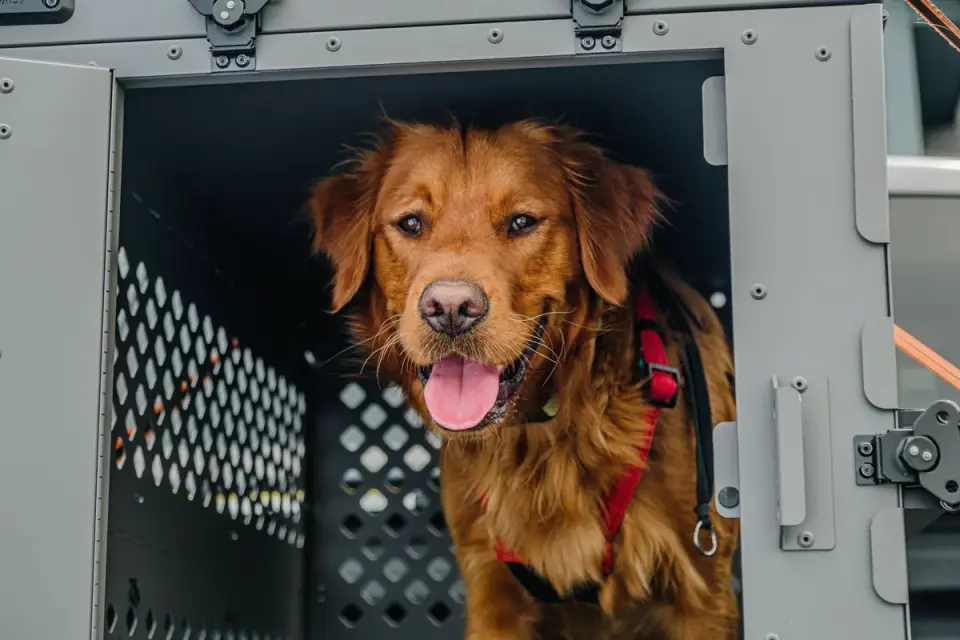
Pack the carrier with a familiar blanket, confirm your airline’s current pet policy and any required paperwork a week out, and arrive early enough that a size or documentation question doesn’t turn into a missed flight. When your own dog’s measurements don’t clear a comfortable margin on any airline’s chart, the more reliable fix is a larger cabin-eligible carrier or a cargo-rated crate built to that airline’s inside-dimension specs — not squeezing into the smallest box that technically fits.
Frequently asked questions
Should I measure my dog standing or sitting?
Standing. Airlines and IATA guidance both call for standing measurements because a seated or curled-up dog reads smaller than the space it needs to comfortably turn around and lie flat in flight.
Do I include the tail in the length measurement?
No. Length is measured from the tip of the nose to the base of the tail, where it meets the body — not to the tip of the tail.
What if my dog is right on the edge of a size limit?
Size up. A carrier that's snug today gets tight fast if your dog gains a pound or shifts position mid-flight, and most airlines will deny boarding rather than debate an inch.
Are carrier size rules the same for every airline?
No. Most US carriers align loosely with IATA's general standard, but exact inside dimensions, weight caps, and under-seat space vary by airline and even by aircraft type, so always check the specific carrier's current policy before buying.
Sources
- Traveler's Pet Corner — IATA
- Travel With a Pet — USDA APHIS
- Kennel Guidelines — American Airlines Cargo